Blog · Updated 2026
Red Light Therapy Form Factors: Find the Device Shape That Fits Your Routine
A practical tour of red light therapy devices: how panels, LED masks, belts, mats, handhelds, bulbs, and hair caps each shine — and which devices we recommend for each form factor.
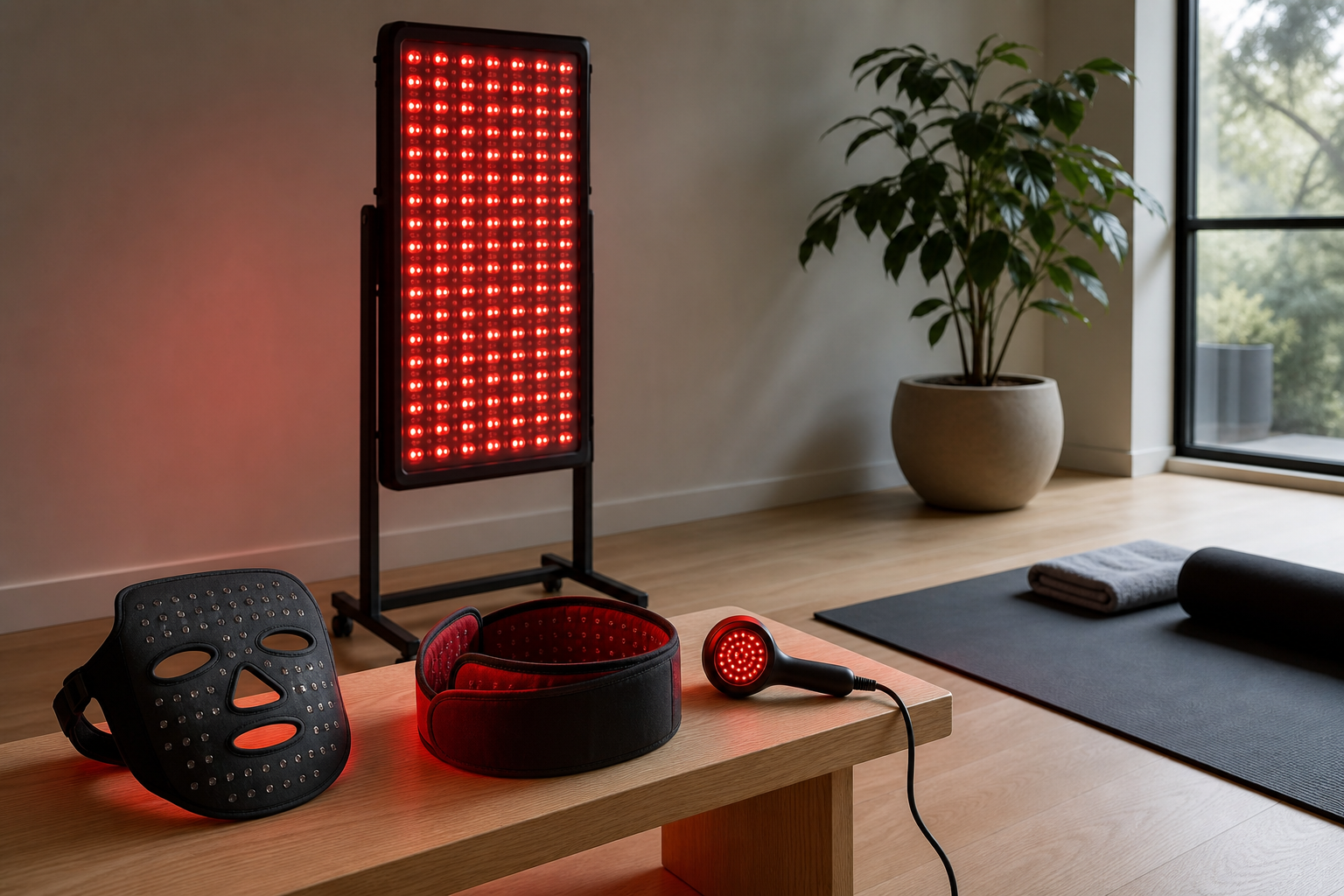
Red light therapy devices come in more shapes than it first appears — and that is good news. A desk panel, a silicone face mask, a waist belt, a compact bulb, and a hair cap can all use familiar red and near-infrared wavelengths. The shape you choose is what makes the routine pleasant, consistent, and well matched to the tissue you care about.
This essay is a friendly form-factor map: which shell fits which goal, plus one preferred Amazon pick for each. For mechanisms, dose vocabulary, and use cases, start with Red Light Therapy: Mechanisms and Use Cases. For panel size, irradiance, and EMF context, use Choosing a Red Light Panel. For where light sits in a recovery stack, The Recovery Protocol is the overview.
Stay here if you are researching types of red light therapy devices and want to match a goal — face, a joint, a torso, a scalp — to a form factor before you shop.
Key takeaways
- Form factor is the first spec. Contact devices (mask, belt, mat, cap) and stand-off devices (panel, bulb, wand) deliver light differently — pick the shape that fits your routine.
- Panels are a versatile home default when you want flexible face-and-body aiming and can keep a steady distance. Preferred starter: Hooga HG300.
- Masks shine for facial skin with a comfortable, hands-free fit. Preferred: CurrentBody Skin Series 2.
- Belts and wraps are easy, focused contact tools for a waist, back, or joint. Preferred: Lifepro Allevared.
- Handhelds and bulbs are handy spot tools; a stand or clamp makes them even easier to use well.
- Mats and beds offer lie-down coverage. A mat or larger panel is usually the more practical home starting point; beds can wait until the habit is established.
- Hair caps are a scalp-specific tool — low-level light for thinning hair, alongside clinical guidance.
- Choose one geometry that matches the tissue, then learn a simple dose. Details and one Amazon pick per form factor are below.
Why form factor matters more than the brand
Photobiomodulation (PBM) is a genuine research field, and the consumer options have never been more approachable. The leading story — red and near-infrared photons interacting with cellular chromophores, especially mitochondrial cytochrome c oxidase — is the same whether the LEDs live in a wall panel or a face mask. The delivered dose still depends on how you use the device.
Three variables help a device succeed in real life:
- Geometry. Stand-off panels work best at a repeatable distance. Contact masks, belts, mats, and caps keep that distance naturally steady.
- Coverage. A compact bulb is perfect for a small region. A mid panel or mat is the better match when you want larger areas in one session.
- Adherence. The most useful device is the one you will enjoy using a few times a week — standing, lying down, or wearing it hands-free.
Wavelength (nm), irradiance (mW/cm² at a stated distance), and fluence (J/cm² = irradiance × time) live in the mechanisms guide. This page answers the practical question those numbers sit on top of: which shell should those LEDs live in?
PBM also tends to follow a biphasic dose pattern: too little does little; a window helps; more is not automatically better. That is a reason to match size and session time to the device you chose — especially when you move from a contact mask to a higher-output panel.
Types of red light therapy devices at a glance
Use this as a chooser, then read the section that matches your goal.
- Panel — vertical stand-off fixture for face, limbs, or torso; you set the distance. A flexible home default.
- LED face mask — contact or near-contact facial coverage; easy cosmetic routines.
- Belt / wrap / pad — contact stripe for waist, back, or a joint; hands-free at a desk.
- Handheld / wand — small, precise targets; travel-friendly when you hold it still.
- Bulb — E26-style dual-band LED for a lamp or included base; an affordable way to start.
- Mat — lie-down contact coverage; a restful large-area session.
- Cap / helmet — scalp-shaped LLLT for hair thinning; its own evidence lane.
- Bed — clinic or luxury full-body enclosure; a later upgrade once a simpler habit is in place.
If the product is mainly a heater that happens to look red, that is a useful thermal tool rather than PBM — see Infrared vs Traditional Heat Physiology and The Thermal Protocol.
Red light therapy panels
Panels are the versatile red light therapy device for people who want one fixture that can aim at a face, a shoulder, or a torso. You stand or sit at a chosen distance. Red (~660 nm) is visible; near-infrared (~850 nm) is not — a gentle session without much warmth is still doing optical work.
What panels do especially well:
- Flexible targeting without needing both a mask and a belt
- Comfortable power for larger regions when you keep a steady distance
- A simple learning loop: timer, stand, and a repeatable mark on the floor
When another shape is even easier:
- Hands-free face time — a mask is wonderfully convenient
- A low-back stripe while you work — a belt keeps you seated
- Front-and-back coverage in one go — a larger panel, a second fixture, or a mat can help
Size is a friendly ladder. A compact dual-chip panel is a great teacher. A mid panel (Hooga HG300 class, around 60 LEDs) is the sweet spot for most homes. 150–300 LED “full-body” panels add coverage when you are ready for fewer pose changes. That ladder — dual-chip vs quad-chip, irradiance, and EMF context — is the job of Choosing a Red Light Panel.
Preferred panel: Hooga HG300. It is the dual-band 660/850 starter we already recommend in the recovery toolkit (Stage 2) and both red-light guides. Grow into a larger panel once the mid-size habit feels easy.
LED face masks
Masks solve a delightful problem: facial skin, a fixed distance, and hands-free time. That is why they are so popular for skincare — and why they work best when facial glow is the named goal, rather than body recovery.
Contact geometry is the real comfort feature. You are not guessing six inches. Many masks also include mixed red/NIR (and sometimes blue) modes. Facial PBM trials exist for wrinkle-related endpoints, which is a genuine skincare evidence stack. Body muscle recovery is a different use case, better served by a panel, belt, or mat.
A mask is a great fit if:
- Cosmetic facial skin is the goal
- You prefer a seated or reclining routine to standing at a panel
- You want a 10-minute session you can do while the kettle boils
If hamstrings or low back are the priority, pair a mask with a panel or belt — or start with those body shapes first. Blue modes, when present, support a different skin job than red/NIR PBM.
Preferred mask: CurrentBody Skin Series 2 — a comfortable, face-mapped cosmetic routine. If you want to try the habit first, the mechanisms guide’s budget pick is an INIA-class mask, then you can step up if you love wearing it.
Red light therapy belts, wraps, and pads
Belts are contact PBM for a focused stripe. Wrap, sit, timer. Distance stays consistent. Coverage is intentionally local, which is exactly right for a waist, a low back, or a joint you can encircle.
Think of a belt as a convenient wrap, not a miniature full-body studio. The mechanism is light rather than heat (if warmth is the main sensation, you may be in thermal-tool territory instead).
Especially useful for:
- Low-back or waist sessions during desk work
- A knee or shoulder when you want to stay seated
- Anyone who prefers a hands-free, sit-down ritual
Preferred belt: Lifepro Allevared — dual 660/850 class, timer, contact wrap, and a friendly price even next to a compact panel. If you later want more area, a panel or mat is a natural next step.
Handheld red light therapy devices and wands
Handhelds are compact and satisfying for small targets. You hold a torch, wand, or mini puck a few inches from skin. Coverage is small by design, so a steady hand (or a simple clamp) helps the dose stay consistent. Consumer LED beams also spread with distance — holding still is the kind habit.
A handheld is a nice match when:
- The target is smaller than a palm (a scar, a knuckle, a small joint)
- You travel and want something that packs easily
- You already own a panel and want a precise finisher
If you want a “portable red light therapy device” for face and larger areas, a compact panel with a stand — BestQool 50W class in the mechanisms guide — is usually the more relaxing everyday setup.
Preferred handheld: Lifepro BioLux wand, when the job really is a tiny target. A stand, wrap, or floor mark makes any small device easier to use well — a theme the panel guide develops in more detail.
Red light therapy bulbs
Bulbs are the most approachable dual-band experiment: a handful of 660/850 LEDs in an E26-style housing, often with a screw-in base and a short cord. They look like a lamp, and they are a low-friction way to learn whether you enjoy the wavelength pair.
Great uses:
- A gentle first step before investing in a panel
- A clamped desk lamp aimed at a face or a small region
- A travel-light option that still uses familiar 660/850 peaks
A ceiling fixture that washes a whole room with a red glow is ambient lighting, not a targeted session. For a measured dose, keep the bulb close to the area you care about, and protect your eyes at short range.
Preferred bulb: Hooga HG24 — 12 dual-chip LEDs, included base, and the same brand family as the HG300, so the wavelength story stays consistent if you later add a panel.
Red light therapy mats
Mats (and some “bags”) offer lie-down, large-area contact. You can rest instead of standing. Coverage can be generous, and adherence is often excellent for people who like a quiet floor session.
Choose a mat if you want simultaneous large-area contact and have floor space. Choose a vertical mega panel if you prefer standing sessions and a fixture that is easy to inspect. Both can deliver full-body-class coverage; they simply feel different to use.
Listings vary in how clearly they report irradiance, so it is worth checking build quality, electrical safety, and the return window. The mechanisms guide’s mat class is a practical category exemplar.
Preferred mat: a dual-band full-body contact mat in that class. Inspect it on arrival. If you prefer a more documented standing fixture, a mega panel from the panel guide is a strong alternative.
Red light therapy caps and helmets
Hair devices are a specialized — and encouraging — corner of the red light world. A cap or helmet is low-level light therapy (LLLT) shaped to a scalp. Wavelengths still cluster in red, and the job is follicles (androgenetic alopecia), not muscle soreness.
That is a separately studied lane, and FDA-cleared hair devices speak to a specific indication. A premium helmet is not “a more serious HG300”; it is a different product for a different goal, which is helpful to know before you shop.
Choose a cap if a clinician agrees that LLLT for thinning hair is a good fit and you can follow the schedule (often every other day, over months). For body recovery or a low-back stripe, a panel or belt will feel more on-target.
Preferred cap: iRESTORE Essential — an entry FDA-cleared laser-and-LED helmet, without jumping straight to the flagship Elite. Hair thinning still benefits from clinical context; the device is a supportive adjunct.
Red light therapy beds
Beds and full-body cabins are the clinic and luxury-home class: lie down, close the lid, and enjoy light from more directions than a single panel. They make coverage and ritual feel effortless. They are also a bigger space and budget decision, so they shine after a simpler device has already become a weekly habit.
There is no preferred Amazon bed on this page, on purpose. For consumer full-body coverage, a mega panel or a mat is the more approachable start. A bed is a natural later step — the same staging logic as Building a Recovery Toolkit.
Trying studio sessions before ownership is a calm way to test the experience, the same way we suggest for float and mild HBOT in The Recovery Protocol.
How to choose a red light therapy form factor
- Name the tissue and the goal. Face cosmetics, a joint, mixed face-and-limb PBM, scalp, or large-area sessions — a clear goal makes the rest easy.
- Pick contact vs stand-off. Prefer contact if you want distance taken care of. Prefer a panel if you want one fixture to aim at many regions.
- Match coverage. Spot, stripe, face, or large-area — then choose a device that covers that job comfortably.
- Learn a simple dose. Irradiance at a stated distance × time. Wattage on the box is a starting clue, not the full prescription.
- Protect eyes and know the medical edges. Bright panels deserve appropriate eye protection. Photosensitizing medications, eye disease, active skin-cancer concerns, and unexplained pain are good reasons to check in with a clinician.
- Stage the spend. A mid panel or a simple contact tool is a joyful first step. Larger panels, mats, beds, or hair helmets can follow — unless hair or face-only cosmetics is already the named job.
Quick matches:
- Learn dual-band home habits: panel (HG300 class)
- Face-only routine you will enjoy wearing: mask
- Low-back while working: belt
- Tiny target or travel experiment: bulb, then maybe a wand
- Prefer lying down, want area: mat
- Thinning hair as the goal: cap, with clinical context
- Full-body standing coverage: mega panel, after a mid panel feels easy
Preferred device for each form factor
One Amazon pick per geometry, so the list stays useful. Compare tables, costs, and reviews live in the Recovery guides. These links are sponsored affiliate links.
- Panel: Hooga HG300 — dual 660/850, timer, stand, the mid-panel default.
- Mask: CurrentBody Skin LED Mask Series 2 — premium face-mapped cosmetic routine.
- Belt: Lifepro Allevared — contact wrap for a waist, back, or joint stripe.
- Handheld: Lifepro BioLux wand — a focused spot tool; a compact panel is usually the easier everyday portable.
- Bulb: Hooga HG24 — an affordable dual-chip start with a base.
- Mat: Full-body red light therapy mat — lie-down contact coverage; check build quality on arrival.
- Hair cap: iRESTORE Essential — entry FDA-cleared laser-and-LED helmet for thinning hair.
- Bed: no Amazon pick yet. A mega panel or mat is a great full-body step until a bed is a remaining, named goal.
Prices, stock, and specs move. Confirm wavelength claims and the return policy on the listing. Editorial picks are independent of commissions — see the disclosure with the sources below.
Getting the most from your first device
- Match the glow to the job. Heat lamps and far-infrared saunas are excellent thermal tools; PBM is a light-dose practice.
- Let each shape do what it does best — a mask for the face, a belt for a stripe, a panel for flexible aiming.
- Look for irradiance at a stated distance when you can, alongside wattage and LED count.
- Give small devices a steady mount — a stand, wrap, clamp, or floor mark.
- Start mid-size, then grow. A mid panel that you use weekly is a happier foundation than a bed you have not tried yet.
- Keep hair devices in the hair lane and recovery panels in the recovery lane. Both can be worthwhile.
- Protect your eyes at close range with bright panels.
Younger athletes building sleep and load habits first can start with Sports Recovery for Young Athletes. Light is a lovely later layer once those defaults are in place.
How the Keersa red light guides fit together
- Map: The Recovery Protocol — where light sits after sleep, movement, and mechanical tools.
- This essay: form factors and one preferred device each.
- Mechanisms: Red Light Therapy: Mechanisms and Use Cases — dose, chromophores, and panels, masks, belts, and mats compared.
- Panel shopping: Choosing a Red Light Panel — size ladder and irradiance in more depth.
- Toolkit staging: Building a Recovery Toolkit — when a mid panel is a joyful Stage 2 addition.
- Thermal cousin: Infrared vs Traditional Heat Physiology.
- Nearby modality: PEMFs and Pulsed Electromagnetic Fields — a different field tool, with its own coverage choices.
The main consumer form factors are stand-off panels, LED face masks, belts and wraps, handhelds and bulbs, full-body contact mats, hair caps or helmets, and clinic-class light beds. They share a helpful wavelength family; the shape you choose still decides coverage, comfort, and dose. Each is better at its own job. A mask is wonderful for facial skin and hands-free time. A panel is the more flexible choice when you want to aim at the face, limbs, or torso and can keep a steady distance. Matching the device to the goal is the win. Yes, for a focused stripe of tissue — low back, waist, or a joint — because contact geometry keeps the distance consistent. A belt is a local wrap you can use while you sit, not a full-body panel substitute, and that focus is part of why it is easy to stick with. They can be, for small, specific targets you can hold still. If you want a portable device for face and larger areas, a compact dual-band panel with a stand is usually the more comfortable everyday choice. A panel is usually a vertical fixture you stand or sit in front of at a repeatable distance. A mat offers contact coverage while you lie down. Same broad physics, different comfort and coverage — pick the session style you will actually enjoy. Low-level light therapy for androgenetic alopecia is a separately studied lane from body-panel recovery. Caps and helmets can be a useful hair-thinning tool for some people, alongside clinical guidance. They are not meant to replace a recovery panel. Most well-designed consumer devices cluster around red (~630–660 nm) and near-infrared (~810–850 nm). Dual-band 660/850 is a reliable default. Extra bands are worth it when a protocol specifically calls for them. They can both glow red, but they do different jobs. Photobiomodulation uses lower irradiances aimed at photochemical signaling. Far-infrared saunas are heat tools. Infrared vs Traditional Heat Physiology is the companion when you want the thermal side.Red light therapy devices FAQ
What are the different types of red light therapy devices?
+
Is a red light panel better than an LED face mask?
+
Do red light therapy belts work?
+
Are handheld red light therapy devices worth it?
+
What is the difference between a red light mat and a panel?
+
Can a red light therapy cap regrow hair?
+
What wavelengths should I look for in a red light therapy device?
+
Is red light therapy the same as an infrared sauna?
+
These notes and references support the claims and recommendations in this post. Product details, study findings, and guidance can change, so treat them as a starting point rather than a final word.
Mechanism backdrop for why red (~630–660 nm) and near-infrared (~810–850 nm) windows dominate serious consumer devices — independent of whether the hardware is a panel, mask, or wrap. Why irradiance, fluence, and tissue type interact — the reason a facial mask, a desk panel, and a full-body mat are not interchangeable “red light.” Consumer LED devices often have wide beam divergence; irradiance collapses with distance — especially relevant for panels, bulbs, and handhelds that are not contact-mounted. Facial PBM RCT with a defined fluence — a cleaner cosmetic evidence stack than treating every LED mask as clinical photobiomodulation. Muscle-focused PBM overview — useful when a recovery claim is being borrowed by a face mask or a 12-LED bulb. Hair-device evidence lane: LLLT for androgenetic alopecia is a different job than body-panel recovery marketing — and dosimetry is still unsettled.
Related Keersa guide: Red Light Therapy — Mechanisms and Use Cases
Dose vocabulary, mechanism, and device mapping across panels, masks, belts, and mats.
Related Keersa guide: Choosing a Red Light Panel
Panel-only buying guide: dual-chip vs quad-chip, irradiance at distance, EMF claims, and the size ladder.
Related Keersa guide: The Recovery Protocol
Where light sits in the recovery order of operations — after sleep, easy movement, and mechanical basics.
Related Keersa context: Infrared vs Traditional Heat Physiology
Separates radiant heat tools from photobiomodulation — both can glow red; they are not the same intervention.
Affiliate disclosure: some product links on Keersa Health may earn a commission at no extra cost to you.
Editorial recommendations are independent of commercial relationships.
Read our full disclosure.
Sources and editorial notes
Bottom line
Shop red light therapy devices by the shape that fits your life. A panel is a flexible stand-off optic. A mask makes facial time easy. A belt covers a comfortable stripe. A bulb or wand handles small spots. A mat is restful large-area contact. A cap is a scalp tool. A bed is a later, spacious upgrade.
Pick the form factor that matches the tissue, choose the preferred device that fits that job, then open Red Light Therapy: Mechanisms and Use Cases for dose and Choosing a Red Light Panel if the panel ladder is next. The Recovery Protocol is there if you want light to sit in a calmer order of operations. That is how the stack can serve you.