Sleep guide · Updated 2026
Sleep Apnea Tech Beyond CPAP: Oral Appliances, EPAP & Positional Therapy
A detailed 2026 guide to sleep apnea options beyond CPAP — custom dental MADs, OTC mouthpieces, Bongo Rx EPAP, positional trainers, Smart Nora, overnight SpO2 monitors, and Inspire — with who they fit and what they cannot replace.
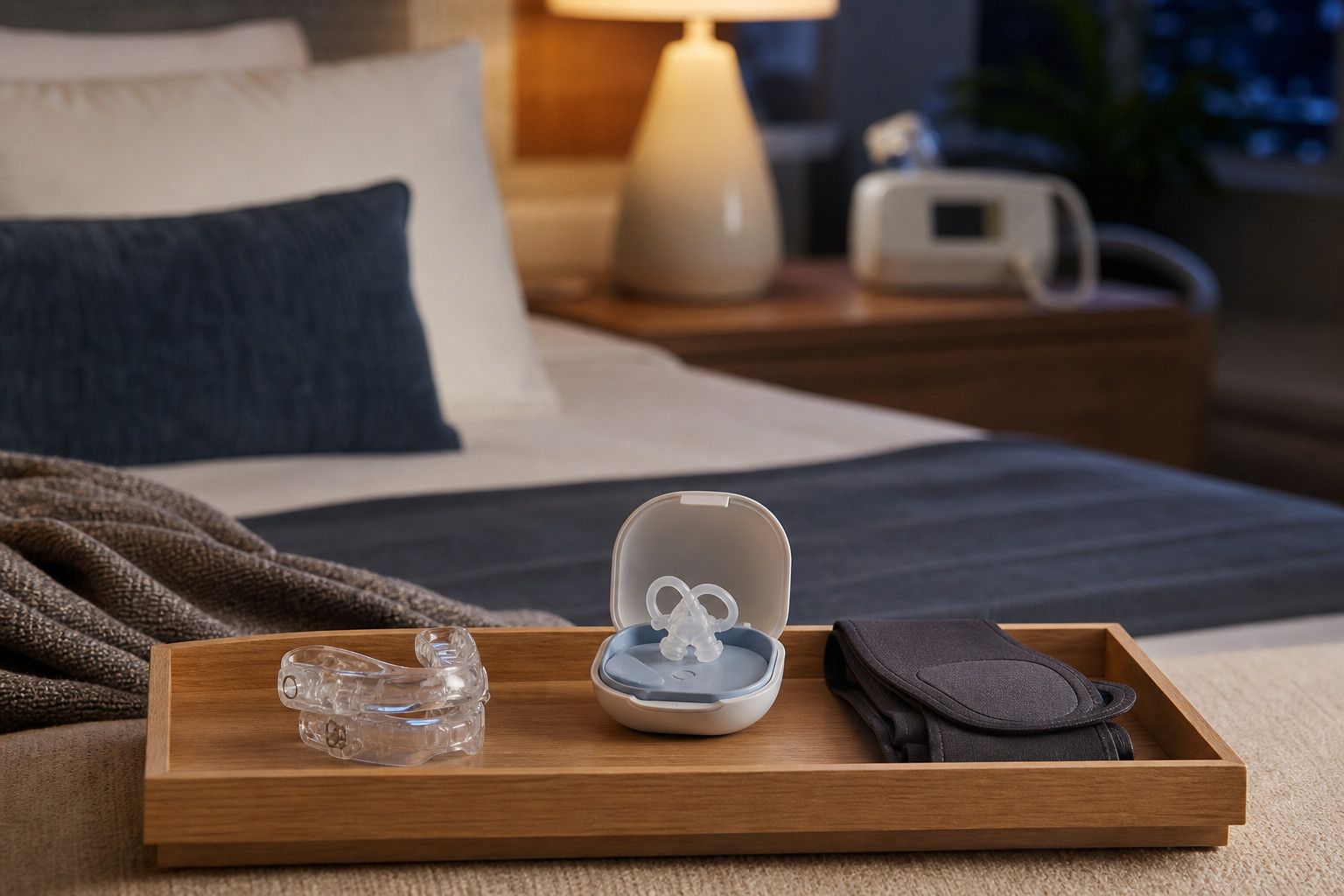
Sleep apnea tech beyond CPAP is a fast-growing conversation in 2026 as more diagnosed patients look for travel-friendly options, dental appliances, and monitoring tools when the machine is hard to tolerate. CPAP remains the most effective therapy for many people with obstructive sleep apnea — but intolerance, travel friction, and anatomy push patients toward oral appliances, EPAP, positional tools, implants, and monitoring gadgets. This guide compares those options without pretending a boil-and-bite mouthpiece is the same as a sleep-medicine plan.
“Beyond CPAP” covers several different product classes. Custom mandibular advancement devices (MADs) are dental appliances that hold the jaw forward. Over-the-counter mouthpieces look similar but sit outside the same supervised pathway. EPAP nasal valves create resistance on exhale without a blower. Positional trainers discourage back-sleeping when events are position-dependent. Overnight SpO2 wearables flag oxygen patterns; they do not diagnose apnea. Hypoglossal nerve implants are a surgical option for carefully selected CPAP failures.
What these options can do — when matched to the right patient — is reduce airway collapse, snoring, or travel friction after diagnosis. What none of them do is replace evaluation. Shop for adjuncts and alternatives after you know your severity and phenotype, not before.
Key takeaways
- Best non-CPAP therapy for many mild–moderate cases: custom dental MAD.
- Best machine-free Rx nasal option: Bongo Rx–class EPAP.
- Best when events are mostly back-sleeping: Night Shift–class positional trainer.
- Best OTC mouthpiece tier (cautious): ZQuiet Advance or Somnofit-S after clinical context.
- Best consumer monitoring adjunct: overnight SpO2 — for signals, not diagnosis.
- Best implant pathway for selected CPAP failures: Inspire-class hypoglossal stimulation.
- Biggest rule: diagnose first; shop second.
Diagnosis first
Obstructive sleep apnea is a medical condition. Consumer snoring products can reduce noise for some people and still leave dangerous airway collapse untreated. Start with symptoms and testing:
- Red flags: gasping, choking, witnessed apneas, refractory sleepiness, morning headaches, resistant hypertension.
- Get evaluated with a clinician-directed home sleep apnea test or polysomnography when indicated.
- Treat the phenotype you actually have: severity, positional dependence, nasal patency, BMI, dental status, and CPAP history.
This article is educational comparison, not a prescription.
How we evaluate beyond-CPAP options
Editorial scores favor pathways that can meaningfully change disordered breathing when used in the right patient — not the loudest “stop snoring” claim. We score across five pillars:
- Clinical appropriateness (30%) — matches known OSA phenotypes and care pathways.
- Effectiveness potential (25%) — realistic AHI/snoring impact for the intended use case.
- Adherence and usability (20%) — comfort, travel burden, nightly friction.
- Risk and supervision (15%) — dental side effects, prescription needs, surgical stakes.
- Ownership cost (10%) — device price plus follow-up reality.
Important limitation: Keersa Health scores are editorial synthesis. They are not device certifications. Firmware, insurance coverage, and eligibility rules change.
Interactive comparison
Filter by form factor, sort by score or price, and pin up to three options for a focused side-by-side view.
Tradeoff:
Sticker price still matters here — most options are one-time hardware buys, so the three-year estimate mainly reflects purchase price plus expected upkeep.
Estimates are directional and based on common public pricing patterns. Promotions, refurbished units, family plans, and tier changes can move these numbers materially.
3-year cost of ownership
Device
Year 1
3-year estimate
Amazon Price
Custom Dental MAD
$1,500
$1,600
—
Inspire Therapy
$30,000
$30,000
—
Bongo Rx
$250
$450
$7.99
Night Shift Positioner
$375
$400
$25.95
Somnofit-S
$150
$170
$149.99
ZQuiet Advance
$90
$100
$89.95
Wellue Overnight SpO2 Monitor
$190
$200
$189.99
SnoreRx Plus
$100
$120
$149.99
Smart Nora
$299
$320
$37.99
Side-Sleep Position Trainer
$60
$80
$59.99
Therapy classes beyond the machine
Oral appliances (MADs)
Mandibular advancement devices hold the lower jaw forward to enlarge the upper airway. Custom dental MADs sit closest to guideline-supported non-CPAP care. OTC boil-and-bite devices (SnoreRx, ZQuiet, Somnofit-class) are cheaper entry points with weaker supervision — useful for selected snoring experiments, risky as silent OSA “treatment.”
EPAP
Expiratory positive airway pressure devices create resistance on exhale through nasal valves. Bongo Rx–class systems can help some mild-to-moderate nasal breathers without a blower — with a prescription pathway and clear exclusions.
Positional therapy
If your AHI collapses when you avoid the back, vibrating position trainers or side-sleep belts can help. If your disease is severe in every posture, positional gadgets will disappoint.
Pillow actuators and snore responders
Smart Nora–class systems move the pillow when snoring is detected. They can reduce partner-disrupting snoring for some households without treating apnea severity.
Monitoring adjuncts
Overnight SpO2 wearables can surface patterns worth clinical follow-up. They do not replace home sleep tests ordered in a care pathway.
Implants
Hypoglossal nerve stimulation (Inspire-class) is specialist surgery for selected CPAP-intolerant patients — high cost, high commitment, real eligibility gates.
Below are deeper notes on every option in the comparison table, sorted by editorial score. Jump directly from the table pins or the cost section.
Dental sleep medicine · Mouthpiece
Best for: Diagnosed OSA or primary snoring when a dentist-supervised oral appliance is appropriate
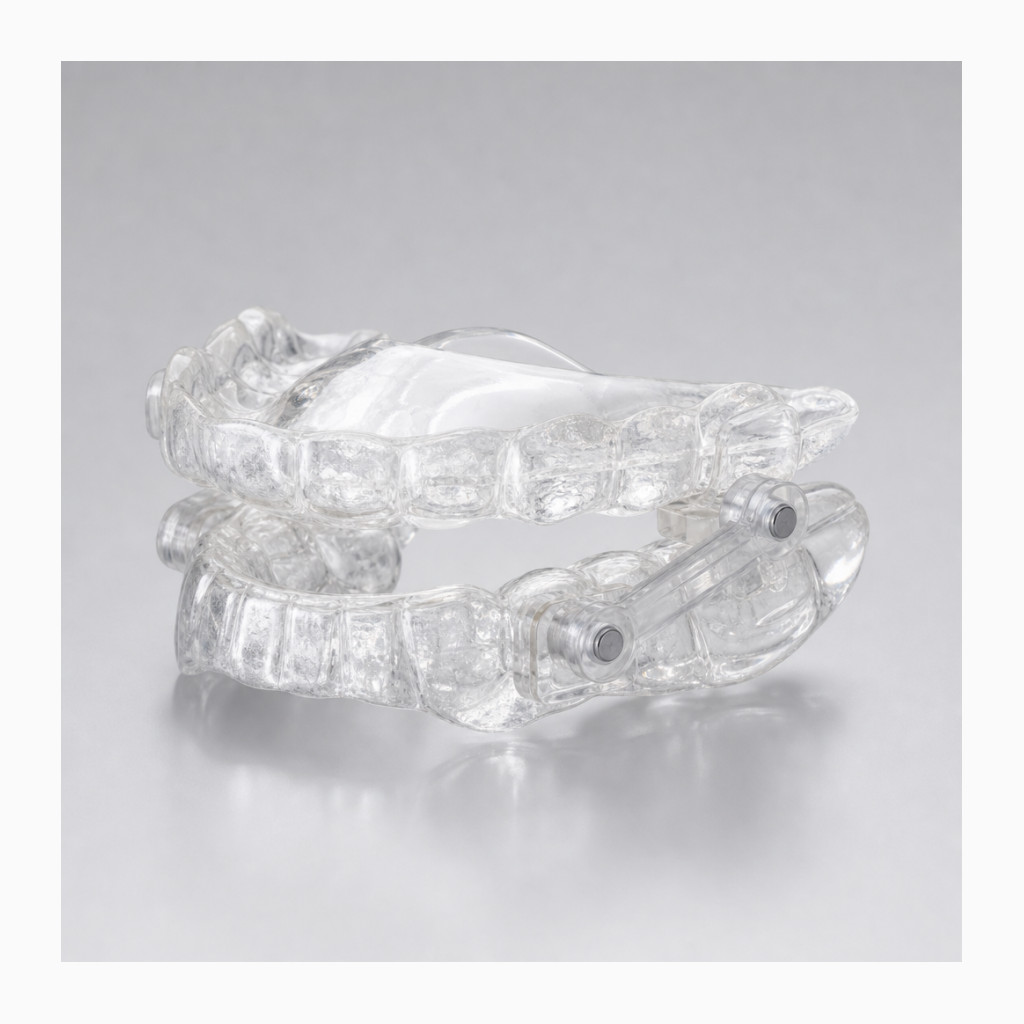
A custom dental MAD is the strongest non-CPAP oral option for many people after diagnosis — fitted and titrated by a qualified dentist, not ordered off Amazon as a DIY cure. CPAP remains first-line for many with OSA; oral appliances are alternatives or adjuncts when a clinician recommends them. Never use any mouthpiece to postpone evaluation if you gasp, choke, or have witnessed apneas. Custom MADs advance the lower jaw to reduce upper-airway collapse. Efficacy and safety depend on diagnosis, dental exam, and follow-up — not on buying the stiffest OTC tray you can find. Side effects (TMJ discomfort, bite changes, morning malocclusion) are reasons to call the prescribing dentist, not to self-adjust advancement aggressively. CPAP is still first-line for many OSA patients. A custom MAD is a clinician-directed pathway when oral appliance therapy is appropriate — not a consumer shortcut around a sleep study.
Estimated ownership: about $1,500 in year 1 and
$1,600 over 3 years.
Typical custom MAD range including fittings; insurance may offset for diagnosed OSA. Year-3 assumes minor adjustments, not a full remake.
Inspire Medical · Implant
Best for: Selected CPAP-intolerant OSA patients who meet implant eligibility after specialist evaluation
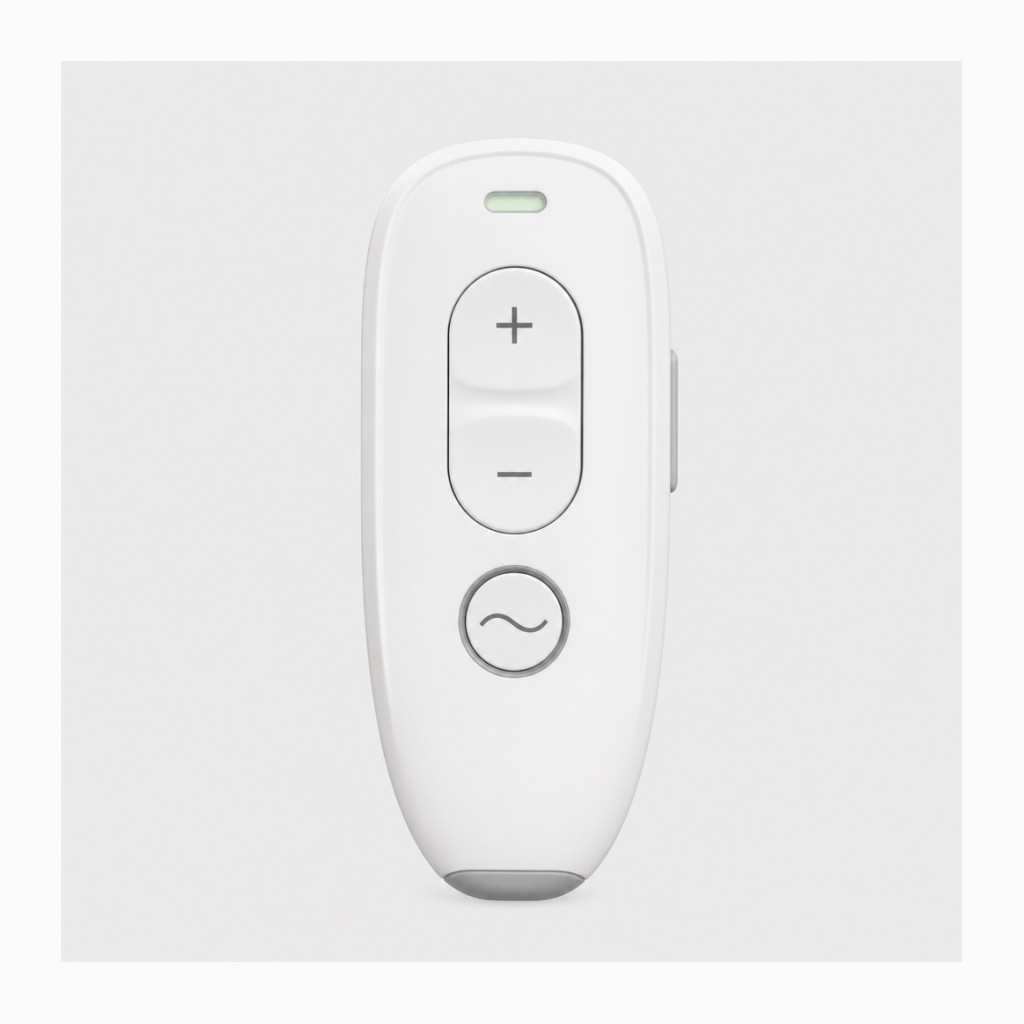
Inspire is implantable hypoglossal nerve stimulation for selected people with OSA who cannot tolerate CPAP and who pass specialist screening — the opposite of a consumer sleep purchase. CPAP remains first-line for many; Inspire is a surgical alternative after diagnosis and failed or refused PAP, never a DIY upgrade path from snoring mouthpieces. Eligibility typically involves OSA severity bands, BMI limits, anatomy (often drug-induced sleep endoscopy), and documented CPAP intolerance — your ENT/sleep team decides, not a product page. Surgery, titration, and remote/clinic follow-up are part of the therapy. This is medical implant care with real risks and benefits. Do not skip CPAP trials or sleep evaluation hoping for an implant. Inspire is a last-mile specialist option inside a care pathway.
Estimated ownership: about $30,000 in year 1 and
$30,000 over 3 years.
Procedure and implant costs dominate; insurance coverage varies widely. Year-3 assumes no major revision — follow-up visits still apply.
AirAvant · Epap
Best for: Prescription EPAP for selected mild-to-moderate OSA in reliable nasal breathers
Bongo Rx is a prescription EPAP option for selected mild-to-moderate OSA after diagnosis — an adjunct/alternative pathway when a clinician says it fits, not a DIY CPAP substitute. You must be able to breathe through your nose. Untreated severe OSA, mouth breathing, or self-ordering “EPAP-like” gadgets without evaluation is the wrong move. EPAP valves raise expiratory pressure to help stent the airway. That only works in the right patient — typically nasal breathers with clinician-selected mild-to-moderate OSA. This is a prescription device pathway. Do not treat lookalike OTC nasal inserts as equivalent medical therapy. CPAP remains first-line for many people. If EPAP fails, congestion blocks use, or symptoms worsen, return to your sleep clinician — do not stack unverified gadgets.
Estimated ownership: about $250 in year 1 and
$450 over 3 years.
Starter kit plus replacement valves/filters over time. Year-3 rises with consumables even without a membership.
Advanced Brain Monitoring · Wearable
Best for: Clinician-managed positional OSA when supine sleep drives events
Night Shift is a clinician-oriented positional trainer that vibrates when you roll supine — useful after diagnosis shows positional OSA, not as a consumer substitute for CPAP or evaluation. Positional therapy is an adjunct/alternative for the right phenotype. If events continue off your back, you still need a broader treatment plan. Positional OSA means events cluster when sleeping supine. A vibration trainer only helps if that phenotype is documented and you actually respond to side-sleeping. This sits in a prescription/clinician-managed lane relative to bargain Amazon “anti-snore” belts. Use it inside a care plan, not as self-diagnosis hardware. CPAP may still be required. Positional therapy does not replace evaluation, and it does not fix non-positional obstruction.
Estimated ownership: about $375 in year 1 and
$400 over 3 years.
Device purchase with minor replacement/accessory assumptions. Clinical pathway pricing can vary by provider.
SnoreLessNow · Mouthpiece
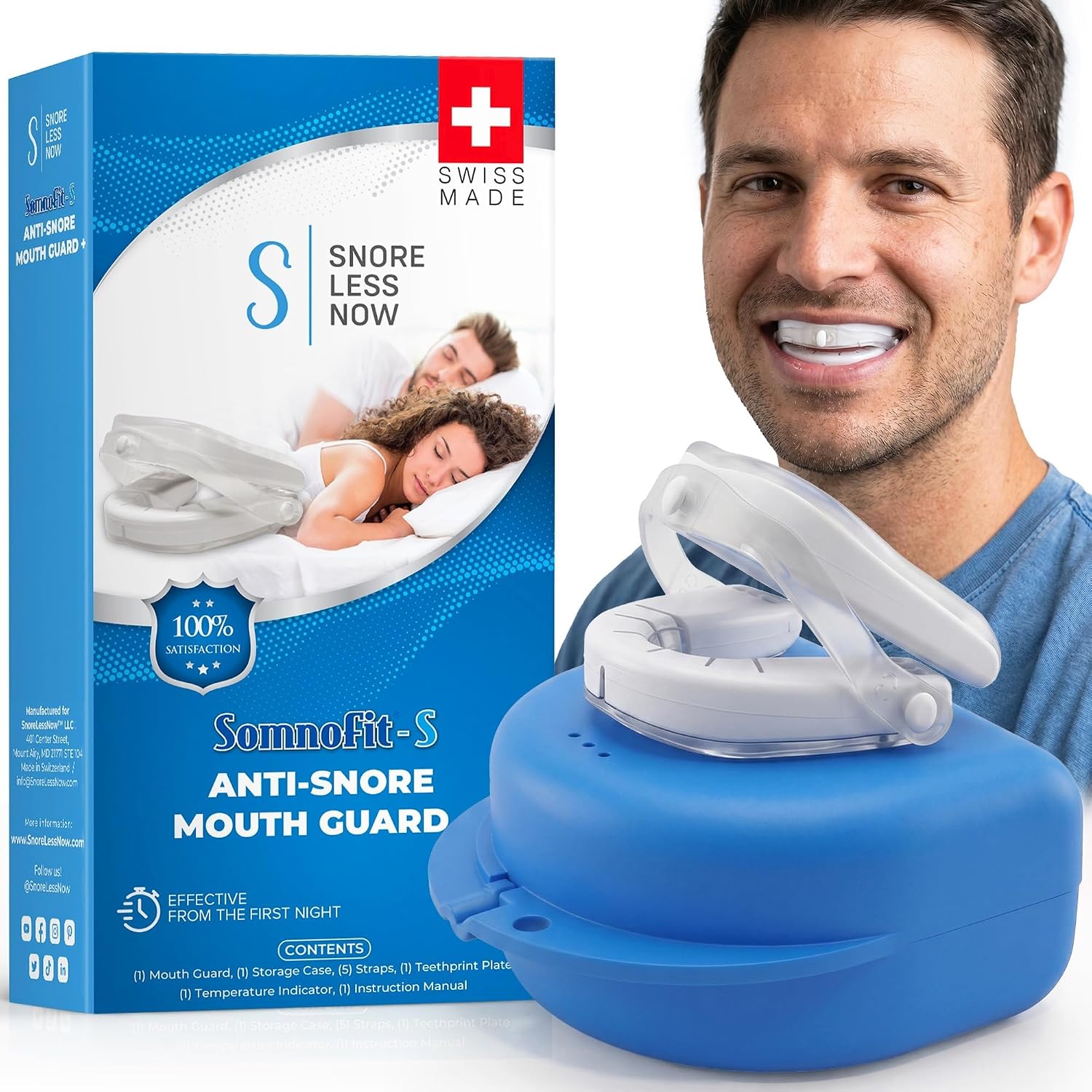
Best for: Higher-end OTC adjustable MAD-style tray for snoring when custom dental care is not yet accessible
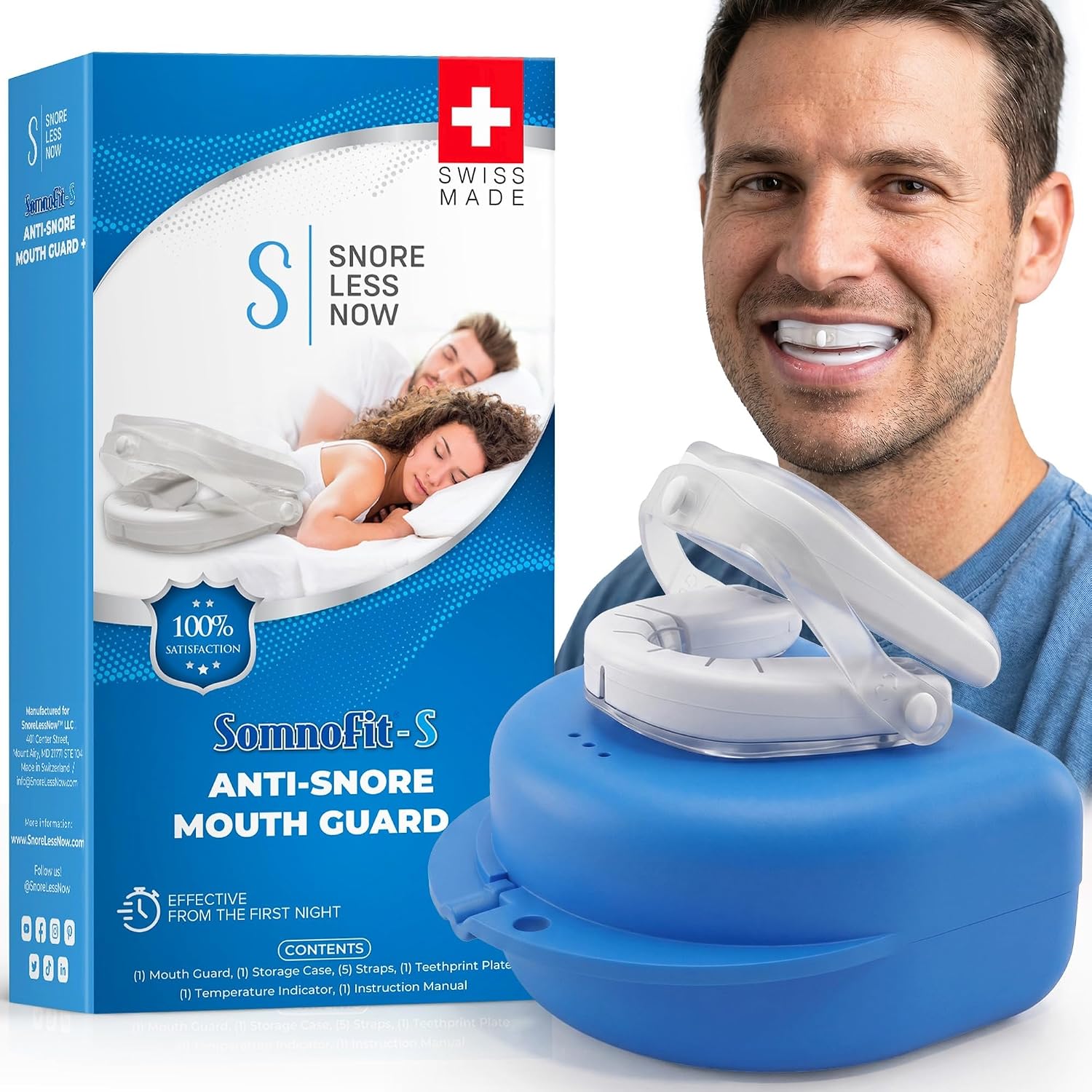
Somnofit-S is a stronger OTC mandibular option on paper than bargain trays, but the editorial line does not change: CPAP first-line for many with OSA, custom dental MADs for supervised oral therapy, and OTC mouthpieces only for snoring / selected mild cases with caveats. Do not use it to delay diagnosis or replace prescribed care. Adjustability helps some users find a tolerable advancement setting, but self-titration is not the same as dentist-guided oral appliance therapy. Compare total value against a referral to dental sleep medicine if you already have an OSA diagnosis — custom fit often matters more than a nicer OTC tray. Stop for pain, tooth mobility concerns, or worsening daytime sleepiness. Those are clinical signals, not reasons to advance the jaw further.
Estimated ownership: about $150 in year 1 and
$170 over 3 years.
Mid-tier OTC hardware plus replacement if the tray fails. Still far below custom dental MAD pricing — and far below its clinical supervision.
ZQuiet · Mouthpiece
Best for: Softer OTC mandibular advancement for snoring when a rigid tray feels intolerable
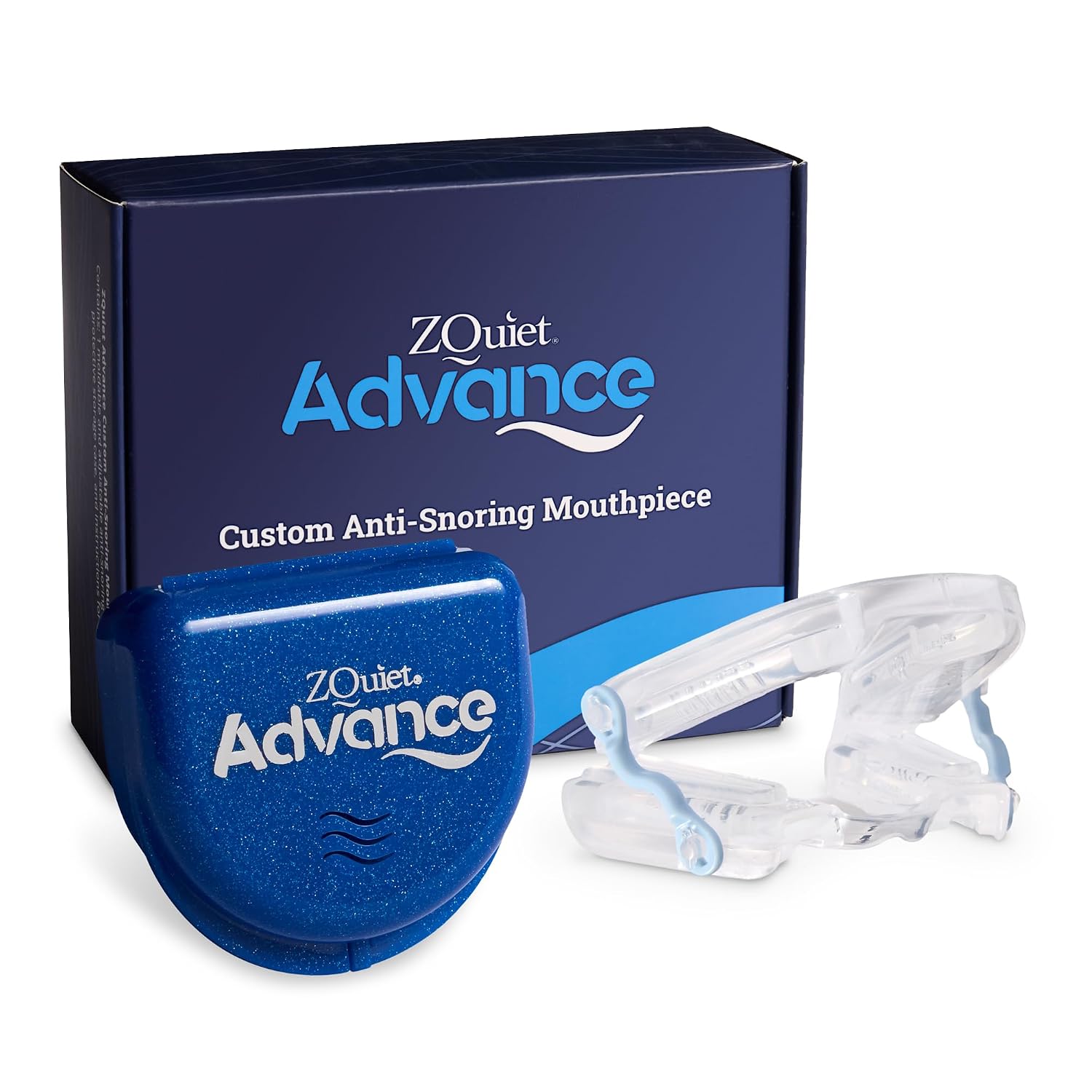
ZQuiet Advance is an OTC soft mouthpiece aimed at snoring reduction via mild mandibular advancement. It can be a comfort-oriented consumer option for primary snoring — not a substitute for CPAP, custom dental therapy, or a sleep evaluation when apnea is suspected. Treat it as a limited adjunct pathway after clearance, never as DIY OSA treatment. Softer materials can improve adherence for people who gag on rigid trays, but comfort does not equal clinical equivalence to a custom MAD. If snoring comes with gasping, choking, or unrefreshing sleep, stop self-experimenting and pursue diagnosis — CPAP or clinician-directed alternatives may be required. Use only with workable nasal breathing and stop for jaw pain. OTC mouthpieces are not prescription oral appliance therapy.
Estimated ownership: about $90 in year 1 and
$100 over 3 years.
One-time hardware cost with occasional replacement. Expect lower precision than a dentist-fitted MAD.
Wellue · Ring
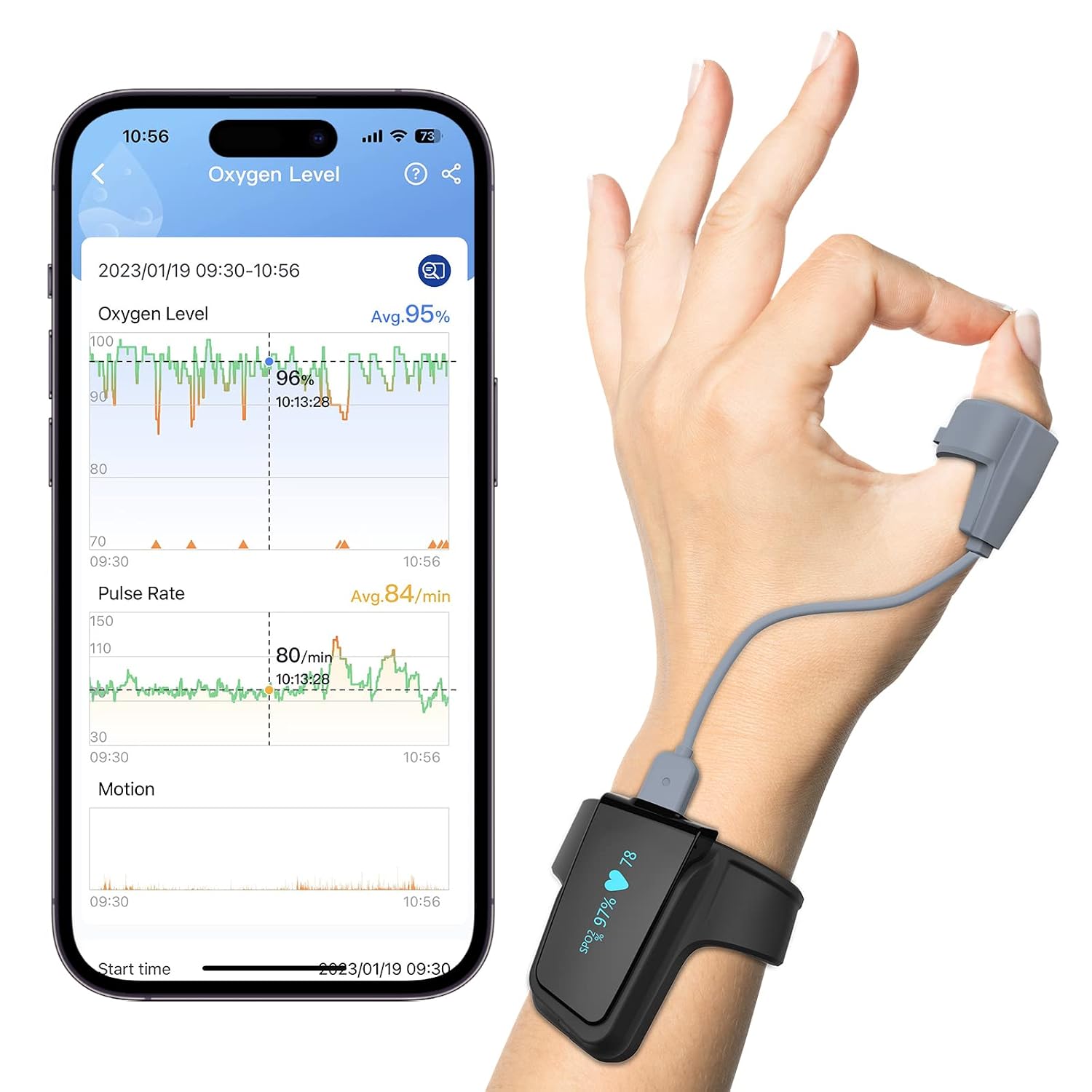
Best for: Overnight oxygen-trend monitoring as a conversation aid — not a diagnosis
The Wellue overnight SpO2 ring is a monitoring tool, not an OSA treatment. It can surface oxygen dips worth discussing with a clinician — it cannot clear you of apnea, replace a sleep study, or stand in for CPAP/MAD/EPAP. Use it to gather questions, not to self-diagnose or self-treat. Continuous consumer SpO2 trends are signals, not diagnoses. Motion artifact, poor fit, and perfusion limits can distort readings. Do not adjust or abandon prescribed therapy based solely on a wellness oximeter. Treatment changes belong with your clinician. If you see frequent desaturations, gasping, or severe sleepiness, seek formal evaluation. Monitoring without a care path is incomplete.
Estimated ownership: about $190 in year 1 and
$200 over 3 years.
Hardware-focused ownership with optional cable/accessory replacement. No membership required.
SnoreRx · Mouthpiece
Best for: OTC snoring trials and selected mild cases — with clear limits versus custom dental MADs
SnoreRx Plus is a popular OTC adjustable mouthpiece for snoring and, in carefully selected mild cases, a short supervised trial — not a DIY replacement for OSA evaluation or CPAP. Custom dental MADs remain the oral-appliance gold standard after diagnosis. If you have gasping, witnessed pauses, or daytime sleepiness, get assessed before advancing your jaw with a boil-and-bite tray. Boil-and-bite devices can reduce snoring for some people by advancing the mandible, but they lack the custom titration and dental oversight of a prescribed MAD. Jaw pain, tooth movement, or bite changes mean stop and talk to a dentist — do not keep advancing settings to chase quieter nights. OTC mouthpieces are for snoring / selected mild pathways with caveats. They are not first-line OSA therapy and never a reason to skip a sleep study when red flags are present.
Estimated ownership: about $100 in year 1 and
$120 over 3 years.
Hardware purchase plus occasional replacement if the tray warps or hygiene declines. Far cheaper than custom dental MADs — and less precise.
Smart Nora · System
Best for: Partner-disturbing snoring when a pillow-based positional nudge is preferable to a mouthpiece
Smart Nora is a pillow-insert snoring system that nudges head position when it hears snoring — a positional comfort tool, not CPAP, not a custom MAD, and not proof you do not have OSA. Use it for snoring annoyance after red flags are addressed clinically. Never treat quieter nights alone as cleared apnea. The system’s job is mechanical repositioning during snoring episodes. That may help some primary snorers and bed partners; it does not stent the airway like PAP or a properly indicated oral appliance. If you gasp, stop breathing, or remain sleepy despite less audible snoring, get evaluated. Silent obstruction can still be dangerous. Prefer clinician-directed positional tools (or PAP/oral appliances) when OSA is diagnosed. Smart Nora is an OTC adjunct for snoring context, not first-line OSA therapy.
Estimated ownership: about $299 in year 1 and
$320 over 3 years.
System purchase with minor accessory/replacement assumptions. No membership required.
Generic · Strap
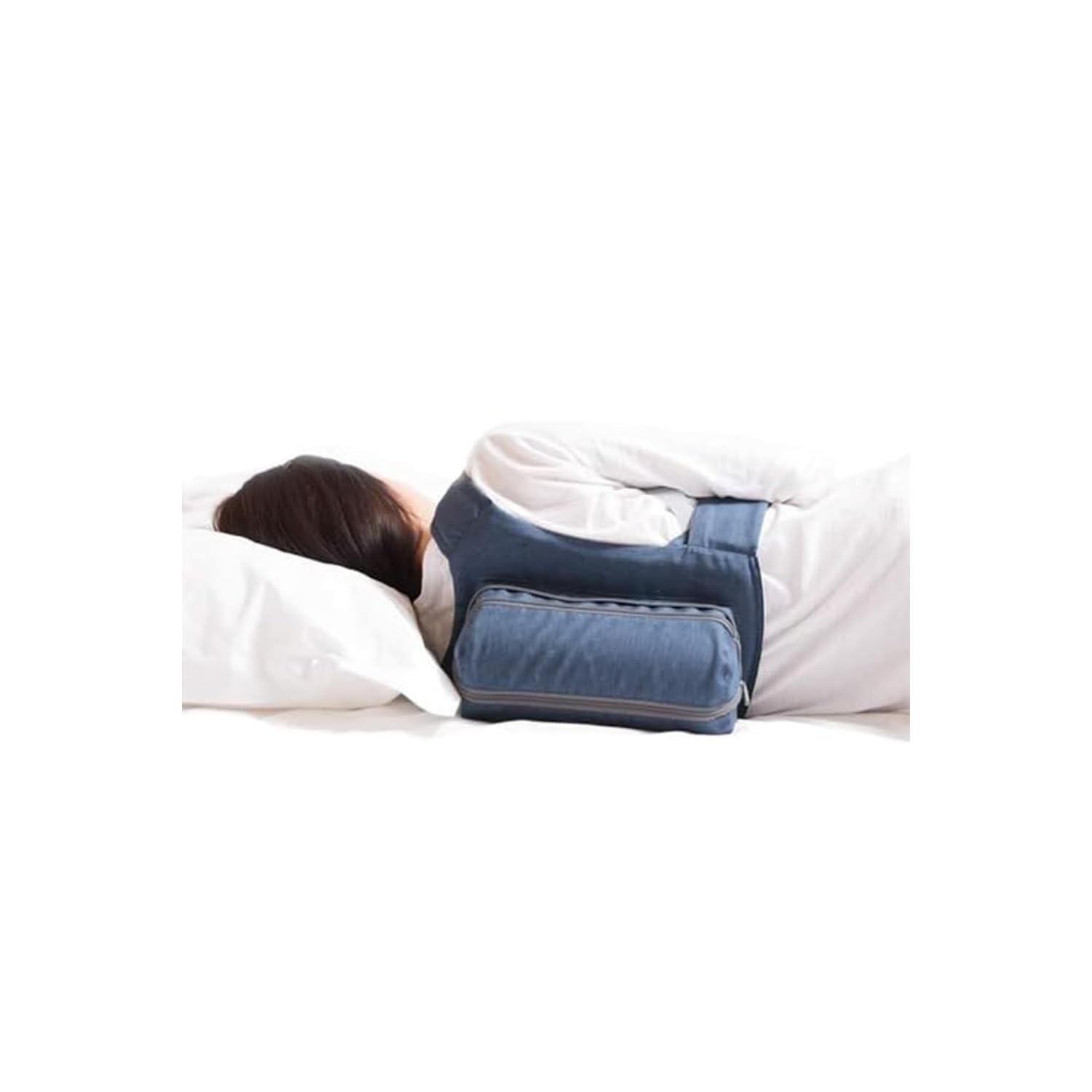
Best for: Low-cost mechanical reminder to avoid supine sleep after positional snoring/OSA is understood
Generic side-sleep trainers are blunt, low-cost positional aids: they discourage supine sleep with foam or straps. They can help some positional snorers as an adjunct after diagnosis — they are not CPAP, not dental therapy, and not a DIY fix for undiagnosed apnea. Confirm the problem is positional before trusting a belt. Mechanical anti-supine belts only matter if sleeping on your back is the main driver of events. Guessing wrong wastes sleep quality. Stop if the strap causes pain, numbness, or worse insomnia. Discomfort that wrecks sleep is a net loss. For diagnosed positional OSA, clinician-grade trainers or formal therapy plans usually beat anonymous Amazon belts — use generics as a cautious adjunct, not a replacement for evaluation.
Estimated ownership: about $60 in year 1 and
$80 over 3 years.
Inexpensive strap with occasional replacement. Price is not the hard part — correct phenotype and clinical context are.
Detailed reviews
Custom Dental MAD
Pros
Cons
Choose this if
Skip this if
Inspire Therapy
Pros
Cons
Choose this if
Skip this if
Bongo Rx
Pros
Cons
Choose this if
Skip this if
Night Shift Positioner
Pros
Cons
Choose this if
Skip this if
Somnofit-S
Pros
Cons
Choose this if
Skip this if
ZQuiet Advance
Pros
Cons
Choose this if
Skip this if
Wellue Overnight SpO2 Monitor
Pros
Cons
Choose this if
Skip this if
SnoreRx Plus
Pros
Cons
Choose this if
Skip this if
Smart Nora
Pros
Cons
Choose this if
Skip this if
Side-Sleep Position Trainer
Pros
Cons
Choose this if
Skip this if
How to choose without getting marketed
- Confirm the diagnosis and severity. Mild positional OSA ≠ severe non-positional OSA.
- Ask whether CPAP can be optimized before abandoning it — mask fit, humidity, pressure relief, and education fix many “failures.”
- Match the class to the phenotype. Dental MAD for selected mild–moderate cases; EPAP for eligible nasal breathers; positional tools for supine-dominant disease; implants only after specialty criteria.
- Prefer supervised devices for true OSA. Custom MADs beat unsupervised OTC mouthpieces when the goal is medical treatment.
- Use consumer monitors as prompts, not answers.
- Re-test when treatment changes. Subjective snoring improvement is not the same as controlled AHI.
Quick recommendations by persona
- Diagnosed mild–moderate OSA, CPAP intolerant: custom dental MAD
- Nasal breather wanting machine-free Rx option: Bongo Rx pathway
- Supine-dominant positional OSA: Night Shift–class trainer
- Partner snoring, low medical risk after clearance: cautious OTC mouthpiece trial
- Want overnight oxygen trend context: Wellue-class SpO2 monitor
- CPAP failure meeting implant criteria: Inspire evaluation
- Budget positional experiment: side-sleep belt/backpack trainer
There is no universal best. For diagnosed mild-to-moderate OSA, a custom dental mandibular advancement device is usually the strongest non-CPAP therapy option. EPAP, positional trainers, and implants fit narrower phenotypes. OTC mouthpieces are closer to snoring experiments than full OSA care. No. Loud snoring, gasping, witnessed apneas, and daytime sleepiness need evaluation. Consumer devices can support care after diagnosis; they should not diagnose or treat unseen airway collapse on their own. Custom MADs are dentist-supervised, adjustable, and aligned with clinical oral-appliance pathways. OTC boil-and-bite devices are cheaper and faster, but fit, titration, and dental risk management are weaker. Use OTC as a cautious snoring trial only when a clinician has already cleared the bigger picture. For some prescription-eligible nasal breathers with mild-to-moderate OSA, EPAP can be a machine-free option — including travel. It is not for everyone, requires a prescription pathway, and fails if you mouth-breathe or need high CPAP pressures. Yes for positional OSA: when events are much worse on the back. Vibrating trainers or side-sleep belts help selected people and do almost nothing for non-positional severe disease. A sleep study phenotype matters more than marketing. Hypoglossal nerve stimulation is an implanted therapy for selected CPAP-intolerant patients after specialist workup. It is surgery plus long-term follow-up — not an Amazon gadget decision. No. Continuous consumer oximetry can flag patterns worth discussing with a clinician. It is not a home sleep apnea test and not a treatment.Sleep apnea beyond CPAP FAQ
What is the best CPAP alternative in 2026?
+
Can I skip a sleep study and just buy a mouthpiece?
+
Custom MAD vs SnoreRx / ZQuiet / Somnofit?
+
Is Bongo Rx a travel CPAP replacement?
+
Does positional therapy work?
+
What about Inspire?
+
Are overnight SpO2 rings diagnostic?
+
This comparison is designed for practical decision-making. Product capabilities, pricing, and memberships change quickly, so treat battery claims, plan costs, and feature availability as moving targets.
AASM clinical practice guideline for diagnostic testing for adult obstructive sleep apnea
Frames CPAP as a primary therapy pathway for many patients and defines when oral appliances, positional therapy, or surgery/implants are considered after evaluation.
AASM/AADSM clinical practice guideline for oral appliance therapy (2015 update)
Supports custom dental MADs for selected patients; OTC boil-and-bite devices are not equivalent to dentist-supervised appliances.
FDA 510(k) premarket notification for Bongo (K180619)
EPAP is a prescription pathway for mild-to-moderate OSA in nasal breathers — not a universal CPAP replacement. Useful when AHI is markedly worse supine; ineffective as monotherapy for non-positional severe disease.
Strollo et al., STAR trial: “Upper-Airway Stimulation for Obstructive Sleep Apnea” (NEJM)
Implant therapy for selected CPAP-intolerant patients after specialist evaluation — not a consumer gadget.
Inspire therapy patient information
Specs, fitting steps, and indications change by SKU; verify current labeling and talk to a clinician for suspected OSA.
Affiliate disclosure: some product links on Keersa Health may earn a commission at no extra cost to you.
Editorial recommendations are independent of commercial relationships.
Read our full disclosure.
Sources and editorial notes
Bottom line
Beyond-CPAP technology is real — and easy to misuse. Custom oral appliances, EPAP, positional therapy, and implants can help the right patient after the right workup. OTC mouthpieces and snore gadgets help some households sleep quieter without proving the airway is safe. Start with diagnosis, keep CPAP in the conversation when it still fits, and escalate to specialty pathways instead of collecting Amazon mouthguards.
Start with the overview if you have not yet: The Sleep Protocol. Related deep dives: mouth taping & nasal devices, wearable trackers, smart beds, and circadian lighting.