Fitness & Mobility guide · Updated 2026
Blood Flow Restriction Training Devices: Cuffs, Pressure & What Actually Matters
A detailed 2026 guide to BFR training devices — wireless auto-LOP cuffs, clinician-style pneumatic kits, and Amazon elastic bands — with safety context and ownership costs.
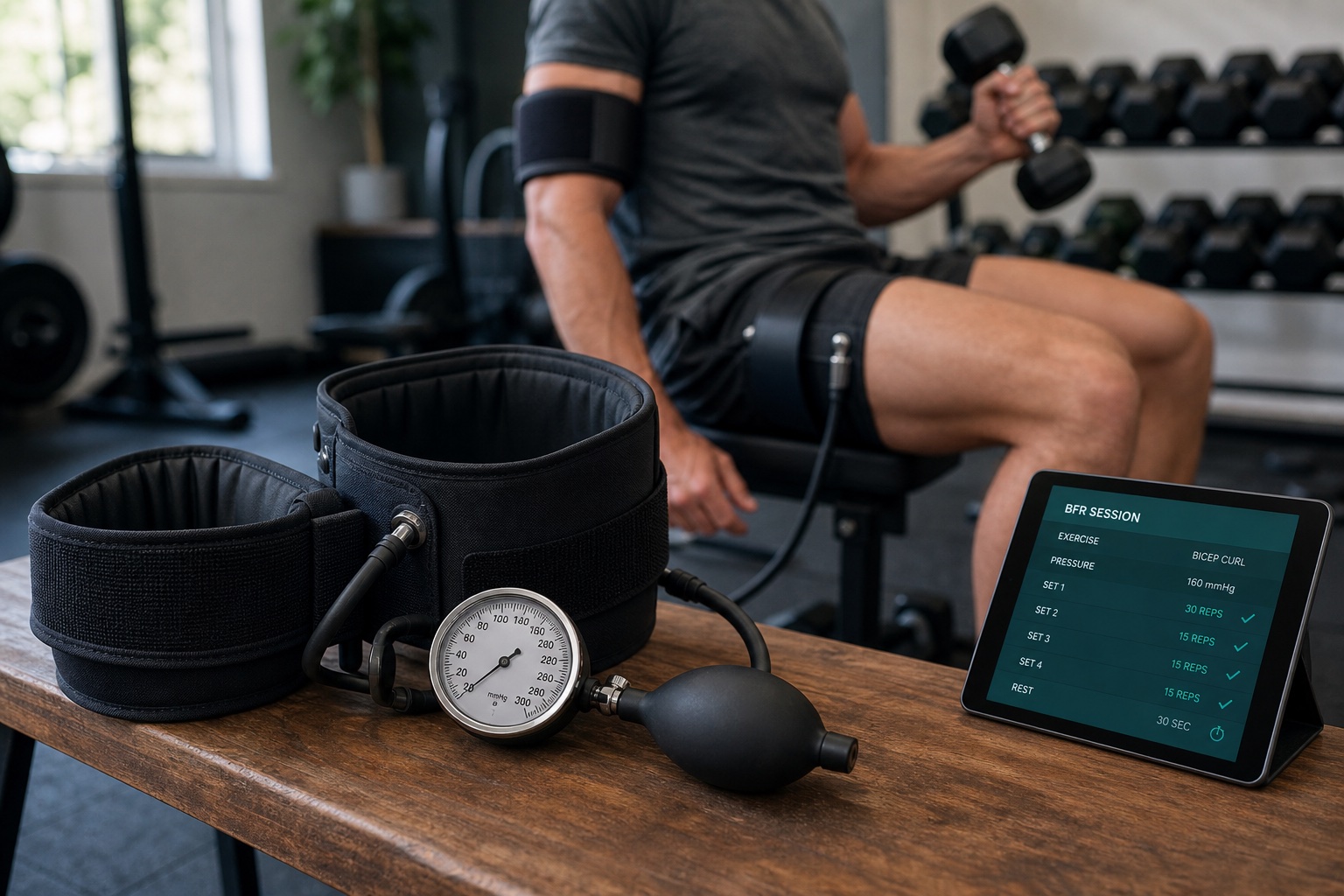
Blood flow restriction training devices promise a rare deal in 2026: meaningful hypertrophy stimulus with lighter loads — if the cuff, pressure, and programming are honest. The category spans wireless auto-calibrating systems, clinician-style pneumatic kits with gauges, and cheap elastic straps. This guide compares popular options everyday athletes can buy and separates personalized-pressure tools from guesswork bands.
BFR partially restricts venous return (and reduces arterial inflow) during low-load exercise, raising metabolic stress. Pneumatic cuffs let you set measurable pressure. Auto-LOP systems estimate limb occlusion pressure for you. Elastic straps only tighten. What these tools do for you is make light-load sessions more hypertrophic when joints, travel, or rehab limit heavy barbell work — not replace screening, progressive overload, or common sense.
Key takeaways
- Best wireless auto-LOP pick: SmartCuffs 4.0 — automatic limb occlusion pressure without a clinic cart.
- Best consumer wireless alternative: SAGA AirBands 2.0 — polished auto-calibrating pairs for home athletes.
- Best clinician-style gauge kit: H+ Cuff — measurable mmHg, wide sizing, Amazon-reachable complete sets.
- Best mid-price pneumatic starter: Occlusion Cuff Elite.
- Best app-guided consumer system: B STRONG Training System.
- Best cheap experiment: BFR Bands Elite 2.0 — with clear pressure limitations.
- Biggest buying mistake: treating “as tight as possible” as a protocol, or expecting elastic straps to deliver research-grade percent-of-LOP prescriptions.
How we evaluate BFR devices
Editorial scores favor tools that improve safe, repeatable BFR for everyday athletes — not clinic prestige alone. We score each option across five pillars:
- Pressure honesty (30%) — gauge, auto LOP, or elastic guesswork.
- Fit and cuff design (20%) — width, limb coverage, comfort under light-load sets.
- Workflow friction (20%) — wireless vs pump, setup time, travel reality.
- Ownership cost (15%) — pair vs multi-cuff kit pricing.
- Buyability (15%) — can an everyday athlete purchase it without a sales maze?
Important limitation: Keersa Health scores are editorial synthesis based on publicly documented features and published BFR methodology themes. They are not medical device certifications. BFR can be inappropriate for some people — verify contraindications with a clinician when needed. Firmware, kits, and marketplace listings change.
How BFR devices actually work
Effective BFR usually combines low external loads (often ~20–40% of 1RM) with partial vascular restriction. Consensus methodology emphasizes individualized pressure relative to limb occlusion pressure, sensible session structure (classic 30-15-15-15 patterns are common in the literature), and stopping for warning symptoms.
Cuff width matters: wider cuffs typically reach occlusion at lower absolute pressures than narrow cuffs. That is why “just use 200 mmHg” advice is often nonsense across products.
Features that matter most
- Personalized / relative pressure — percent of LOP beats vibes.
- Measurable mmHg — minimum for serious home use.
- Cuff width and sizing — arms and legs are different problems.
- Workflow you will repeat — wireless helps adherence; pumps teach transparency.
- Safety literacy — screening and stop rules beat any SKU.
Interactive comparison
Filter by form factor, sort by score or price, and pin up to three options for a focused side-by-side view.
Tradeoff:
Sticker price still matters here — most options are one-time hardware buys, so the three-year estimate mainly reflects purchase price plus expected upkeep.
Estimates are directional and based on common public pricing patterns. Promotions, refurbished units, family plans, and tier changes can move these numbers materially.
3-year cost of ownership
Device
Year 1
3-year estimate
Amazon Price
SmartCuffs 4.0
$519
$559
—
SAGA AirBands 2.0
$369
$409
—
H+ Cuff BFR System
$719
$759
$349
Occlusion Cuff Elite
$170
$190
$89
B STRONG Training System
$479
$529
$214.95
BFR Bands Elite 2.0
$35
$55
$15.99
Form factor decides the precision. Wireless auto-LOP cuffs estimate occlusion for you. Pneumatic gauge kits make pressure visible. Elastic straps only tighten.Wireless auto-LOP vs pneumatic gauge vs elastic straps
Choose wireless auto-LOP if...
Choose a pneumatic gauge kit if...
Choose elastic straps if...
Get medical clearance first if...
Below are deeper notes on every option in the comparison table, sorted by editorial score. Jump directly from the table pins or the cost section.
SmartTools · Cuff
Best for: Wireless auto limb-occlusion-pressure calibration without a clinic console
SmartCuffs 4.0 is the everyday-athlete / clinician hybrid pick when you want wireless BFR with automatic limb occlusion pressure rather than guessing with elastic straps. It sits well above Amazon elastic bands on safety workflow — and below full surgical-tourniquet clinic stacks on complexity. Personalized pressure is the whole point of modern BFR devices. Auto-LOP systems reduce the biggest beginner failure mode: cranking a narrow band until it hurts and calling that “science.” You still need contraindications screening, sensible loads (often ~20–40% 1RM), and stop rules for numbness/dizziness. Hardware does not replace judgment. Choose SmartCuffs if you will use BFR weekly and want wireless LOP. Skip it if you only want a cheap experiment and will not personalize pressure.
Estimated ownership: about $519 in year 1 and
$559 over 3 years.
Assumes one pair plus minor replacement cables/wear. Clinical multi-cuff sets cost substantially more.
SAGA Fitness · Cuff
Best for: Consumer-friendly wireless auto-calibrating BFR without a hand pump
SAGA AirBands 2.0 popularized wireless auto-calibrating BFR for athletes who want less pump drama. For everyday users, the value is adherence: cuffs you will actually put on twice a week beat a “better” clinic cart you never buy. Auto calibration is the headline feature. Treat manufacturer occlusion percentages as starting points inside consensus ranges — not as a medical prescription. If you train both upper and lower body with BFR, budget for the right limb sizes rather than forcing one pair onto everything. Choose SAGA for polished wireless consumer BFR. Skip it if you prefer a hand-gauge clinic kit or absolute cheapest entry.
Estimated ownership: about $369 in year 1 and
$409 over 3 years.
Assumes one pair (arm or leg). Full arm+leg bundles are closer to ~$600 before tax.
H+ Cuff · Cuff
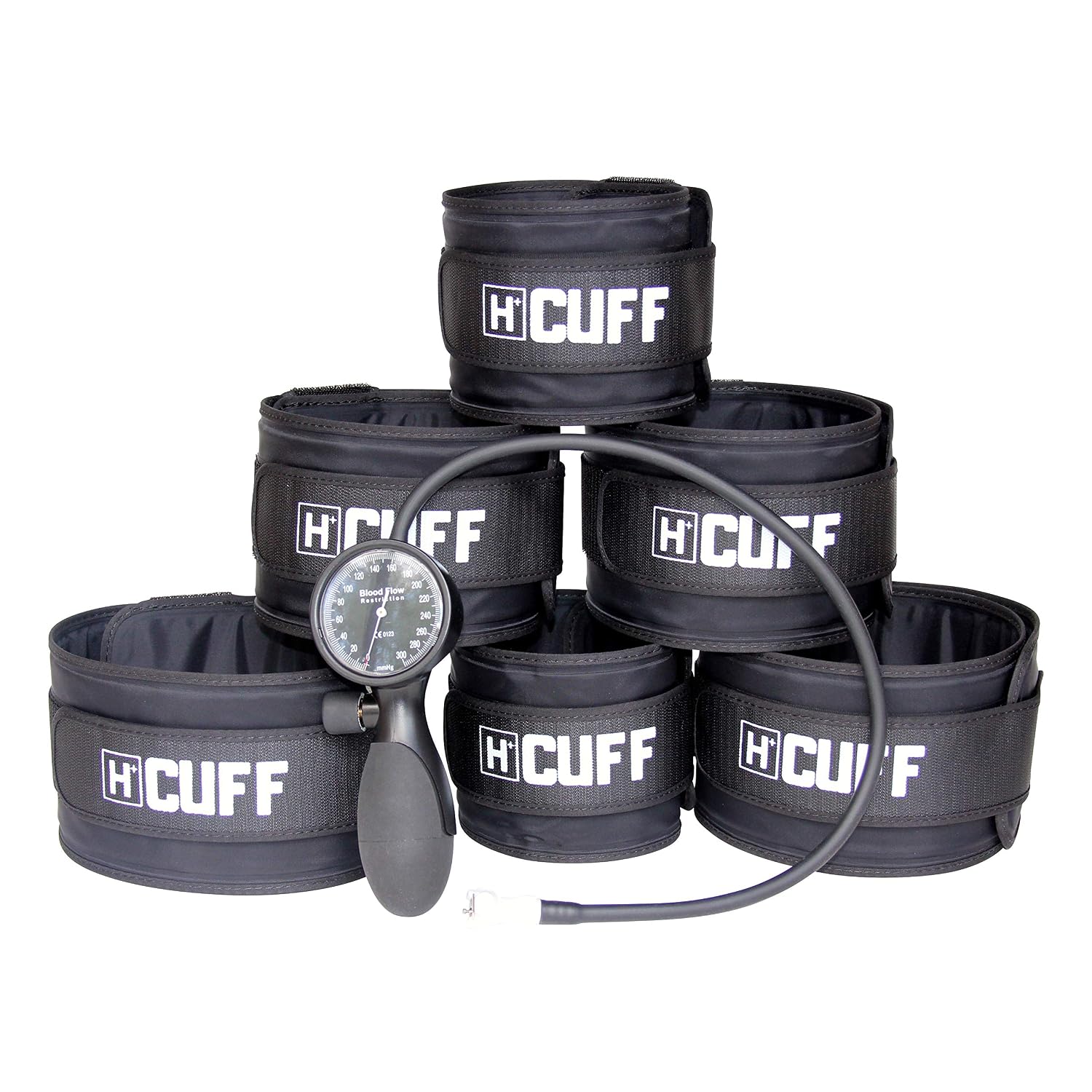
Best for: Clinician-style pneumatic cuffs with a real pressure gauge and wide sizing options
H+ Cuff is the practical “clinic method without wireless hype” pick: pneumatic cuffs, a gauge, and sizing that can fit more limbs than a single fashion band. It rewards people willing to learn personalized pressure instead of chasing a magic number on TikTok. A gauge does not automatically equal safe pressure. You still need a relative target (percent of LOP) and a way to estimate occlusion — especially on legs. Wide, well-fitting cuffs matter. Narrow straps often need absurd absolute pressures to feel “restricted,” which is a comfort and safety smell test. Choose H+ if you want durable pneumatic hardware and measurable pressure. Skip it if you want fully automatic wireless LOP.
Estimated ownership: about $719 in year 1 and
$759 over 3 years.
Complete multi-cuff kits sit near ~$699; individual pairs are far cheaper. Confirm what each Amazon listing includes (pump, bag, course).
The Occlusion Cuff · Cuff
Best for: Mid-price pneumatic BFR with a gauge for arms and legs
Occlusion Cuff Elite is a sensible step up from elastic straps: you can set and repeat a pressure instead of guessing by “how tight it feels.” For many everyday athletes, that is the minimum viable BFR hardware. Pneumatic + gauge beats elastic for repeatability. It does not automatically equal individualized percent-of-LOP unless you measure occlusion somehow. Confirm cuff width and limb coverage on the exact SKU you buy — marketplace bundles vary. Choose this if you want affordable pneumatic BFR. Skip it if you want wireless auto calibration.
Estimated ownership: about $170 in year 1 and
$190 over 3 years.
One-time hardware estimate for a pair + pump. Replace bladder/hose parts if they leak.
B STRONG · System
Best for: App-guided multi-chamber BFR with a strong consumer training narrative
B STRONG sells BFR as a guided training system more than a clinic tourniquet clone. That can be a feature for adherence — and a limitation if your priority is classic wide-cuff LOP measurement. Multi-chamber designs intentionally distribute pressure differently than single-chamber pneumatic cuffs. Do not assume every BFR product is interchangeable with research cuffs. Use the app as a programming aid, not as proof that any absolute pressure is optimal for your limb. Choose B STRONG for guided consumer BFR. Skip it if you specifically want wide single-chamber cuffs and easy LOP checks.
Estimated ownership: about $479 in year 1 and
$529 over 3 years.
Complete kits vary; spare bands alone are cheaper and are not a full system. Verify pump + case inclusion.
BFR Bands · Band
Best for: Cheap portable entry into occlusion-style training with clear limits
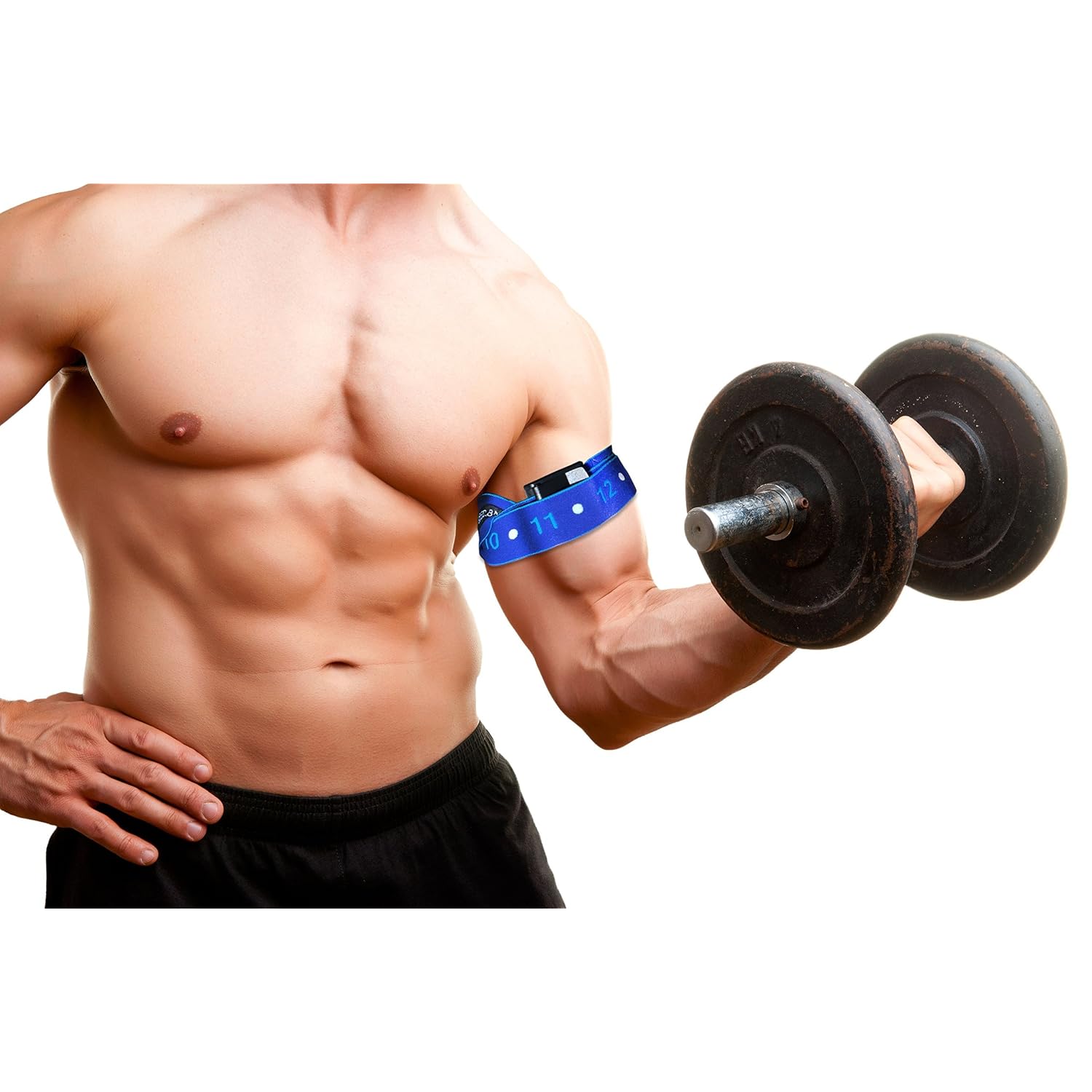
BFR Bands Elite 2.0 are the honest budget entry: elastic occlusion straps you can pack in a gym bag. They can teach the metabolic-stress sensation of BFR — they cannot give you personalized occlusion pressure. If research protocols in your head say “80% LOP,” elastic straps cannot deliver that prescription. Use perceived tightness scales cautiously and prefer quitting early over chasing numbness. Marking systems help left/right consistency, which is better than pure vibes — still not a gauge. Choose elastic bands to experiment cheaply. Upgrade to pneumatic or auto-LOP if BFR becomes a weekly tool.
Estimated ownership: about $35 in year 1 and
$55 over 3 years.
Hardware only. Expect to replace straps if stitching/buckles wear.
Detailed reviews
SmartCuffs 4.0
Pros
Cons
Choose this if
Skip this if
SAGA AirBands 2.0
Pros
Cons
Choose this if
Skip this if
H+ Cuff BFR System
Pros
Cons
Choose this if
Skip this if
Occlusion Cuff Elite
Pros
Cons
Choose this if
Skip this if
B STRONG Training System
Pros
Cons
Choose this if
Skip this if
BFR Bands Elite 2.0
Pros
Cons
Choose this if
Skip this if
How to choose the right setup
- Decide the job. Rehab-adjacent precision, weekly hypertrophy accessory, or a cheap curiosity test?
- Prefer measurable pressure. Gauge or auto LOP before elastic straps for anything serious.
- Match cuff to limb. One fashion band rarely fits both biceps and thighs well.
- Budget the kit, not the photo. Arm + leg pairs and multi-size clinic sets multiply cost.
- Learn a simple protocol. Light loads, controlled reps, short sessions, clear stop rules.
- Escalate hardware only if you stick with it. If you quit after two sessions, the $30 band already answered the question.
Quick recommendations by persona
- Wireless auto-LOP athlete: SmartCuffs 4.0
- Polished consumer wireless: SAGA AirBands 2.0
- Clinic-style gauge buyer: H+ Cuff
- Best value pneumatic: Occlusion Cuff Elite
- App-guided system fan: B STRONG
- Budget experiment: BFR Bands Elite 2.0
Evidence reviews generally find low-load BFR can produce hypertrophy similar to traditional high-load training when programmed well. Maximal strength still usually favors heavy loading. BFR is a tool for metabolic stress and rehab-friendly loading — not a free pass to skip progressive overload forever. Modern guidance prefers a percentage of limb occlusion pressure (often roughly 40–80% of LOP depending on goal and limb), not a random fixed mmHg copied from social media. Wider cuffs typically need lower absolute pressures than narrow cuffs. If your device cannot help estimate LOP, be conservative and stop for numbness, tingling, or dizziness. They can be a low-cost experiment, but they offer no measured pressure and are easy to overtighten. Serious or clinical use is better served by pneumatic cuffs with a gauge or wireless auto-LOP systems — plus medical screening when relevant. Common red-flag categories discussed in clinical commentaries include clotting disorders / DVT risk, poorly controlled hypertension, pregnancy, and other vascular concerns. This is not a diagnosis checklist — get medical clearance if you have cardiovascular, clotting, or post-surgical risk factors. No. Auto LOP is the convenience and consistency upgrade. A good pneumatic kit with a gauge can work if you learn relative pressure. Elastic straps are the entry experiment, not the precision tool. No. Rehab is a major evidence use case when heavy loads are limited, but healthy athletes also use BFR for accessory hypertrophy, travel training, and deload-friendly volume. It should not replace all heavy compound work if your goal is maximal strength.Blood flow restriction training devices FAQ
Do BFR devices actually help build muscle with light weights in 2026?
+
What pressure should I use?
+
Are elastic BFR bands safe?
+
Who should not use BFR?
+
Do I need wireless auto-calibrating cuffs?
+
Is BFR only for rehab?
+
This comparison is designed for practical decision-making. Product capabilities, pricing, and memberships change quickly, so treat battery claims, plan costs, and feature availability as moving targets.
Expert position stand on BFR loads, pressures as a percent of limb occlusion pressure, session structure, and safety screening. Meta-analysis: BFR with low loads can match high-load hypertrophy, while high-load training still tends to win for maximal strength. Supports BFR as a rehabilitation tool when heavy loading is limited — useful context for post-op and joint-sensitive athletes. Shows wider cuffs reach arterial occlusion at lower absolute pressures than narrow cuffs — a core buying criterion. Explains why fixed mmHg recipes fail across cuff widths and why relative pressure (percent of occlusion) is preferred. Clinician-facing argument for individualized limb occlusion pressure rather than one-size-fits-all inflation.
Lorenz, Bailey, Wilk et al., “Blood Flow Restriction Training” (Journal of Athletic Training, 2021)
Practical overview of common side effects, contraindications, and implementation caveats for practitioners.
SAGA Fitness, AirBands 2.0 product documentation
Wireless auto-calibration features and kit contents change by region; verify current specs before purchase.
SmartTools, SmartCuffs 4.0 product documentation
Manufacturer claims for automatic limb occlusion pressure calibration and wireless control; confirm model and clinical listings.
Affiliate disclosure: some product links on Keersa Health may earn a commission at no extra cost to you.
Editorial recommendations are independent of commercial relationships.
Read our full disclosure.
Sources and editorial notes
Bottom line
Blood flow restriction is real — and easy to do badly. Buy the cheapest device that lets you repeat a personalized pressure you understand, train light on purpose, and stop when your body says stop. Wireless auto-LOP is the convenience upgrade; pneumatic gauges are the transparency upgrade; elastic straps are the experiment. None of them replace screening or smart programming.
Related: Force Plates for Everyday Athletes, Wearable HRV and Training Readiness, and Vibration Platforms and Neuromuscular Stimulus.