Fitness & Mobility guide · Updated 2026
Vibration Platforms and Neuromuscular Stimulus: Hz, Amplitude & What the Research Actually Supports
A detailed 2026 guide to whole-body vibration platforms — tri-planar research-range plates, pivotal/high-end consumer systems, and Amazon oscillating boards — with honest limits on bone and fat claims.
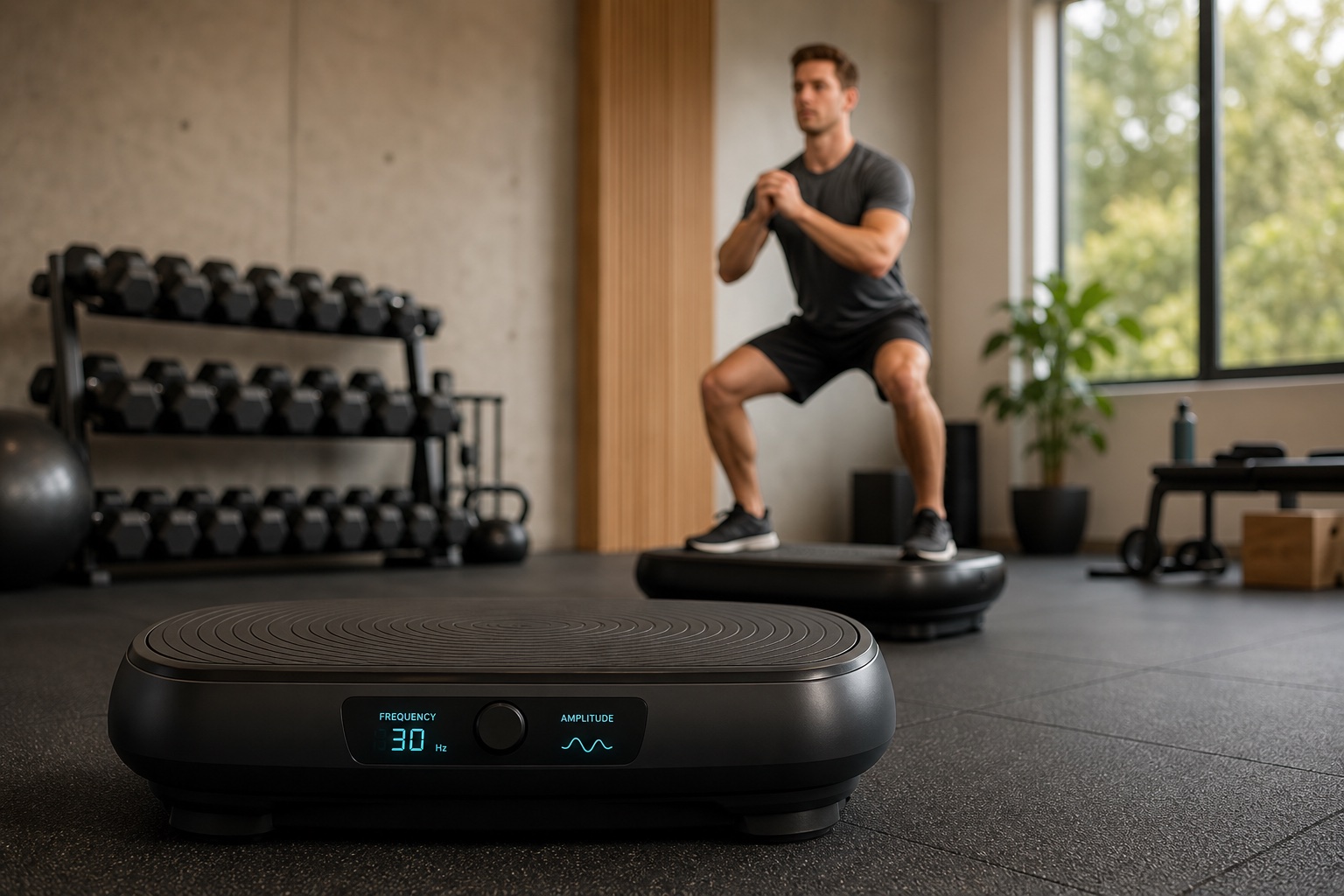
Vibration platforms and neuromuscular stimulus sit in an awkward 2026 marketplace: clinic-adjacent research devices on one shelf, Bluetooth-speaker Amazon oscillators on the other, and ads that blur them together. Whole-body vibration (WBV) can raise muscle activation through rapid stretch and reflex pathways — but frequency, amplitude, and vibration type decide whether you bought a useful tool or an expensive foot massage.
Tri-planar / vertical platforms move the surface in ways that show up often in neuromuscular studies. Pivotal / oscillating plates rock side to side. Multi-motor “4D” boards mix modes for consumer variety. What these tools do for you is add a controllable mechanical stimulus for short priming, isometric holds, and recovery adjuncts. They do not replace progressive strength training, and they are not a bone-density or fat-loss vending machine.
Key takeaways
- Best research-range home plate: Power Plate MOVE — tri-planar stimulus in familiar ~30–40 Hz bands.
- Best high-end pivotal alternative: Hypervibe G17.
- Best Amazon multi-mode pick: Lifepro Rumblex 4D.
- Best budget oscillating starter: Lifepro Waver.
- Best compact budget alternative: Bluefin Fitness Ultra Slim-class plates.
- Best cheap habit test: MERACH Vibration Plate.
- Biggest buying mistake: equating “99 speeds” with research-grade Hz/amplitude control — or expecting WBV alone to rebuild bone and body composition.
How we evaluate vibration platforms
Editorial scores favor tools that deliver an honest, repeatable neuromuscular stimulus for everyday athletes — not speaker watts or miracle claims. We score each option across five pillars:
- Stimulus honesty (30%) — vibration type, published Hz/amplitude, and whether claims match the hardware class.
- Training usefulness (20%) — priming, isometrics, recovery adjunct value.
- Build and durability (20%) — motor quality, noise, weight capacity.
- Ownership cost (15%) — sticker price versus likely years of use.
- Buyability (15%) — Amazon path vs specialty retail.
Important limitation: Keersa Health scores are editorial synthesis based on publicly documented specs and published WBV themes. They are not lab certifications. Marketplace SKUs change; verify frequency and amplitude on the exact listing. Medical clearance matters for some users.
How whole-body vibration actually works
Rapid platform motion repeatedly stretches muscle-tendon units and can increase motor-unit recruitment via reflex pathways often discussed as a tonic vibration reflex. Meta-analyses support increased lower-limb EMG activity and some explosive-power metrics after WBV — especially around common research frequencies near 30 or 50 Hz. Athlete performance transfer is less consistent because protocols vary wildly.
Reporting guidelines keep reminding researchers (and buyers) to publish frequency, amplitude/peak acceleration, and device type. If a listing only says “99 speeds,” you are buying vibes.
Specs that matter most
- Vibration type — oscillating vs pivotal vs tri-planar / multi-motor.
- Frequency (Hz) — many consumer oscillators sit ~4–12 Hz; research neuromuscular work often uses higher bands.
- Amplitude / acceleration — intensity is not speed number cosplay.
- Session design — short bouts, soft knees, clear stop rules.
- Honesty about outcomes — activation adjunct ≠ hypertrophy plan ≠ guaranteed BMD fix.
Interactive comparison
Filter by form factor, sort by score or price, and pin up to three options for a focused side-by-side view.
Tradeoff:
Sticker price still matters here — most options are one-time hardware buys, so the three-year estimate mainly reflects purchase price plus expected upkeep.
Estimates are directional and based on common public pricing patterns. Promotions, refurbished units, family plans, and tier changes can move these numbers materially.
3-year cost of ownership
Device
Year 1
3-year estimate
Amazon Price
Power Plate MOVE
$3,045
$3,145
—
Hypervibe G17
$2,045
$2,145
—
Lifepro Rumblex 4D
$360
$420
$399.99
Lifepro Waver
$210
$250
$199.99
Bluefin Fitness Ultra Slim
$190
$240
$349
MERACH Vibration Plate
$140
$200
$79.99
Form factor and motion type decide the stimulus. Tri-planar / research-range plates target familiar neuromuscular frequencies. Pivotal / oscillating plates rock the platform. Budget multi-motor boards maximize modes and Amazon convenience.Tri-planar vs oscillating vs budget multi-motor
Choose a research-range / tri-planar plate if...
Choose a high-end pivotal plate if...
Choose an Amazon oscillating / 4D plate if...
Skip vibration plates for now if...
Below are deeper notes on every option in the comparison table, sorted by editorial score. Jump directly from the table pins or the cost section.
Power Plate · Platform
Best for: Tri-planar vibration in research-familiar frequency bands without a full commercial tower
Power Plate MOVE is the everyday-athlete entry into a brand clinicians and performance centers recognize. It prioritizes tri-planar vibration in frequency bands that show up repeatedly in neuromuscular research — not the low-Hz massage-wave feel of many budget plates. Vibration type matters as much as the marketing word “plate.” Tri-planar / vertical-lineal research platforms are not the same stimulus as side-to-side oscillating consumer boards. Use it for short neuromuscular priming, isometric holds, and recovery adjuncts. Do not expect it to replace squats, jumps, or bone-loading sports. Choose MOVE if frequency honesty and build quality dominate. Skip it if you only want a cheap recovery wobble for under $300.
Estimated ownership: about $3,045 in year 1 and
$3,145 over 3 years.
Hardware-focused estimate. Sale pricing varies widely; confirm accessories (mat, straps) in the exact kit.
Hypervibe · Platform
Best for: High-end pivotal / oscillating performance plates with wide frequency control
Hypervibe G17 sits in the serious home / boutique-studio tier: a pivotal vibration platform with more honest performance positioning than Bluetooth speaker plates. Buy it when you want tunable frequency and amplitude without pretending a $199 board matches clinic research setups. Pivotal (see-saw) oscillation and vertical/tri-planar vibration are different mechanical inputs. Compare like with like when reading studies. Frequency readout you can trust beats “99 speeds” with no real Hz transparency. Choose Hypervibe for high-end pivotal training. Skip it if you specifically want Power Plate-style tri-planar hardware.
Estimated ownership: about $2,045 in year 1 and
$2,145 over 3 years.
Assumes base platform. Shipping/import and accessories can move the total.
Lifepro · Platform
Best for: Amazon-reachable multi-motor “4D” plates with mode variety for home adherence
Lifepro Rumblex 4D is the feature-dense Amazon pick when you want oscillating + multi-motor modes without spending Power Plate money. Treat it as a convenient neuromuscular / recovery adjunct — not as a portable research lab. Mode count is not evidence quality. Prefer plates that publish frequency and amplitude honestly over plates that only say “99 speeds.” Great for habit formation and light isometric work. Weak as a sole hypertrophy or bone-density plan. Choose Rumblex for versatile home use. Skip it if you need verified 30–50 Hz research-class settings every session.
Estimated ownership: about $360 in year 1 and
$420 over 3 years.
One-time hardware. Budget for a replacement if motors get noisy after heavy daily use.
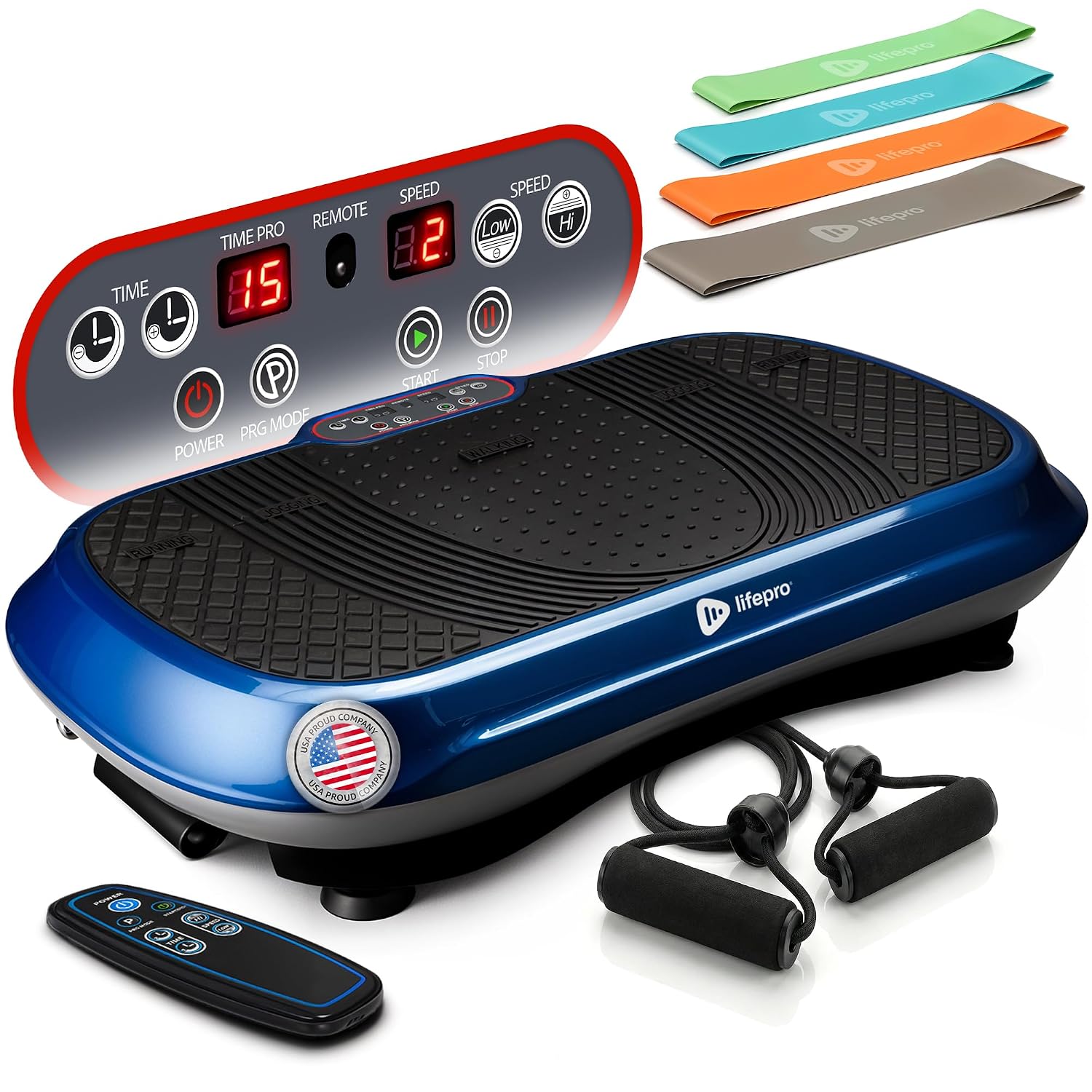
Lifepro · Platform
Best for: Affordable oscillating vibration for circulation, warm-ups, and low-impact sessions
Lifepro Waver is the default Amazon oscillating plate many people actually buy. It is useful for gentle neuromuscular noise, warm-ups, and adherence — and a bad match if your mental model is “NASA bone plate at 30+ Hz.” Oscillating side-to-side motion can feel productive at low frequencies. That does not automatically equal the EMG/power findings from higher-frequency research platforms. Start short. Knees soft. Stop for dizziness, joint pain, or headache. Choose Waver to experiment cheaply. Upgrade if you outgrow low-Hz oscillation.
Estimated ownership: about $210 in year 1 and
$250 over 3 years.
Hardware plus occasional band replacements. Confirm current warranty terms on the listing.
Bluefin Fitness · Platform
Best for: Compact budget oscillating plate when footprint and price dominate
Bluefin Ultra Slim-class plates are the space-saving Amazon alternative to Lifepro Waver. Buy for convenience and gentle oscillating stimulus; do not buy for clinic-grade neuromuscular programming. Model lines change often. Compare published Hz/amplitude and weight capacity on the exact SKU, not the brand reputation alone. Bluetooth speakers are entertainment, not training quality. Choose Bluefin for compact budget entry. Skip it if you already know you need multi-motor or tri-planar hardware.
Estimated ownership: about $190 in year 1 and
$240 over 3 years.
Budget hardware. Confirm which exact Bluefin generation the listing ships.
MERACH · Platform
Best for: Cheapest honest experiment before committing to a nicer plate
MERACH-class plates are the “prove you will use it” option. If a $130 oscillator collects dust, a $3,000 Power Plate would have collected dust faster. Use it to test posture, session length tolerance, and whether vibration makes you dizzy before upgrading. Do not use budget plates to evaluate the entire evidence base for WBV. Choose MERACH for a cheap experiment. Upgrade once the habit sticks and the stimulus feels limiting.
Estimated ownership: about $140 in year 1 and
$200 over 3 years.
Expect possible replacement within a few years of daily use. Price is the feature.
Detailed reviews
Power Plate MOVE
Pros
Cons
Choose this if
Skip this if
Hypervibe G17
Pros
Cons
Choose this if
Skip this if
Lifepro Rumblex 4D
Pros
Cons
Choose this if
Skip this if
Lifepro Waver
Pros
Cons
Choose this if
Skip this if
Bluefin Fitness Ultra Slim
Pros
Cons
Choose this if
Skip this if
MERACH Vibration Plate
Pros
Cons
Choose this if
Skip this if
How to choose the right platform
- Write the job. Research-range priming, gentle recovery, or a cheap experiment?
- Demand real specs. Prefer Hz and amplitude over opaque speed ladders.
- Match vibration type to expectations. Do not compare oscillating comfort to tri-planar research platforms.
- Buy the cheapest plate you will use weekly. Dust is the most expensive feature.
- Keep training primary. Strength, jumps, and protein still do the heavy lifting.
- Escalate only if limited. If a Waver habit sticks and you want higher-frequency control, then look at Hypervibe / Power Plate.
Quick recommendations by persona
- Research-range home athlete: Power Plate MOVE
- High-end pivotal buyer: Hypervibe G17
- Amazon multi-mode: Lifepro Rumblex 4D
- Budget oscillating starter: Lifepro Waver
- Small-space budget: Bluefin Ultra Slim
- Habit experiment: MERACH
Yes — meta-analyses report increased lower-limb neuromuscular activation and some explosive-power metrics after whole-body vibration, especially in protocols using roughly 30 or 50 Hz. Effect sizes and transfer to sport performance are protocol-dependent, not magical. No. Many Amazon plates use low-frequency side-to-side oscillation (~4–12 Hz). Premium tri-planar platforms often operate in higher research-familiar bands (~30–40+ Hz). Both vibrate. They are not interchangeable stimuli. Do not bet your health plan on that. Bone-density evidence is mixed and often modest; fat-loss marketing usually outruns the literature. Treat WBV as an adjunct to training, protein, sleep, and progressive loading. Start short (a few minutes), soft knees, and conservative amplitude. Prefer devices that display real frequency (Hz) and amplitude rather than opaque “speed” numbers. Stop for dizziness, headache, joint pain, or nausea. People with acute injuries, recent surgery, uncontrolled cardiovascular issues, pregnancy concerns, severe osteoporosis risk, or balance disorders should get clinician guidance first. WBV is not automatically “gentler than exercise.” No. Use it as a warm-up/potentiating or recovery adjunct if it helps you. Keep jumps, strength work, and skill practice as the primary neuromuscular drivers.Vibration platforms and neuromuscular stimulus FAQ
Do vibration platforms actually stimulate muscles in 2026?
+
Is a $200 oscillating plate the same as a Power Plate?
+
Will a vibration plate build bone density or melt fat by itself?
+
What settings should I use?
+
Who should be cautious with whole-body vibration?
+
Should athletes use WBV instead of plyometrics?
+
This comparison is designed for practical decision-making. Product capabilities, pricing, and memberships change quickly, so treat battery claims, plan costs, and feature availability as moving targets.
Meta-analysis reporting increased lower-limb neuromuscular activation and explosive-power metrics after WBV protocols commonly using ~30 or ~50 Hz. Athlete-focused synthesis showing mixed performance outcomes and highlighting how vibration type, frequency, amplitude, and protocol duration drive heterogeneity. Foundational review framing vibration as a neuromuscular exercise stimulus rather than a passive “shake weight” gadget. Mechanistic overview of tonic vibration reflex concepts, transmission, and practical limits of whole-body vibration exercise. Delphi consensus on reporting frequency, amplitude, acceleration, and device type — useful for decoding marketing Hz claims. Evidence for bone outcomes is protocol-dependent and often modest — keep bone-density marketing claims in perspective. Overview finding inconsistent advantages for BMD across systematic reviews — useful caveat for “builds bone overnight” ads.
Power Plate MOVE product documentation
Tri-planar frequency ranges and accessories change by SKU/region; verify current specs before purchase.
Lifepro Waver / Rumblex product documentation
Consumer oscillating and multi-motor platforms; published Hz ranges are manufacturer claims and often sit below classic research bands.
Affiliate disclosure: some product links on Keersa Health may earn a commission at no extra cost to you.
Editorial recommendations are independent of commercial relationships.
Read our full disclosure.
Sources and editorial notes
Bottom line
Whole-body vibration can be a real neuromuscular stimulus — when frequency, amplitude, and device type are honest. Buy for short, repeatable sessions that fit beside real training, not for miracle recomposition. Start cheap if you are unsure; pay Power Plate money only when you know you want research-range hardware and will use it.
Related: Force Plates for Everyday Athletes for objective lower-body output, Blood Flow Restriction Training Devices for light-load hypertrophy tools, Wearable HRV and Training Readiness for recovery context, and Smart Resistance Equipment for connected strength systems.